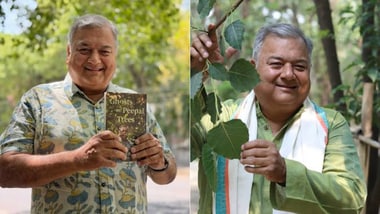
The is meant to make travel between the two cities much faster. But while the highway has drawn attention for its scale and the time it will save commuters, an environmentalist has been quietly working on something very different along the route. Swami Prem Parivartan, better known as Peepal Baba, says he has planted 40,000 sheesham trees along the expressway. He now wants to add another four lakh.
What makes his effort unusual is the way he goes about it. Peepal Baba and his team often work at night, digging the ground and planting saplings under the cover of darkness. Speaking at the 11th edition of the Himalayan Echoes festival, he described how the team gets the work done before daybreak.
“By 10.30 at night we are digging; by 4 o’clock we have done it,” he said.
According to him, the next phase of the plantation drive is planned for February 2027. The target is to plant another four lakh trees along the highway.
Peepal Baba’s association with trees goes back to his childhood. Born as Swami Prem Parivartan, he began planting trees when he was just 10 years old. His first recorded plantation was on 26 January 1977, when he planted a tree at Pune Military Station.
Over the years, what started as a childhood interest became a lifelong mission. He eventually founded Give Me Trees Trust, an organisation that works with volunteers to plant and protect trees across India.
He earned the name Peepal Baba because of his long-standing work with peepal trees. However, his plantation drives are not limited to one variety. His organisation works with several native species, including banyan, neem, and sheesham.
According to Give Me Trees Trust, its work has helped plant and preserve around 25 million trees. The organisation also works with schools, colleges and local communities, encouraging people to take up plantation drives and care for the saplings after planting them.
Peepal Baba has also written about his experiences in his book, Ghosts on Peepal Trees: My Journey from Folktales to Forests. His work has largely centred on a simple idea: planting a tree is only the beginning. It also needs to survive and grow.
The plantation drive comes at a time when the environmental impact of the Delhi-Dehradun Expressway has been a subject of discussion. The 213-km corridor, built at a cost of more than ₹12,000 crore, is designed to cut the journey between Delhi and from over six hours to around two-and-a-half hours.
The highway also passes through areas that are important for wildlife. To reduce its impact, the project includes a 12-km elevated wildlife corridor, animal passages and dedicated underpasses.
However, the construction has also involved the removal and transplantation of trees. In a parliamentary response in July 2025, the Ministry of Road Transport and Highways said 17,913 trees had been felled or transplanted foafforestat
r the project. It also mentioned compensatory across 157.2 hectares and plans for 50,600 avenue trees within the highway’s right of way.
This is where Peepal Baba’s work along the route becomes particularly relevant. He wants to bring more greenery to the stretch and believes that tree plantation should be part of how people think about large projects.
His approach is not limited to planting as many saplings as possible. He has also spoken about the need to protect older trees, pointing out that a mature tree cannot be replaced overnight by planting a new one. Saplings need years of care before they can offer the same shade and ecological benefits.