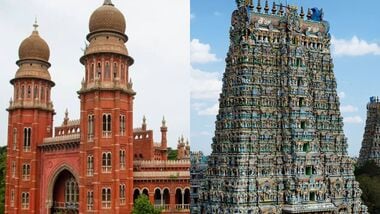
The Madras High Court has ruled that non-Hindus who refuse to pledge reverence or abide by traditional customs cannot be allowed entry into Agamic temples in Tamil Nadu. In a recent order, the Madras HC division bench comprising Justices G R Swaminathan and P Murugan noted that allowing non-Hindus who sport their religious markers or fail to furnish the requisite undertaking showing their reverence to the deity to enter temple premises would compromise their sanctity.
The court, however, made it clear that the ruling applies strictly to Agamic temples. An Agamic temple is a Hindu shrine built, consecrated and maintained according to Agama shastras, ancient manuals that prescribe every detail of temple life.
The court also directed authorities to strictly enforce rules, ensuring that age-old traditions and temple entry rules are rigorously upheld without caving to political expedience.
The Court observed that there are egregious breaches in recent times, noting MLA Badrudeen Mustafa entering the Meenakshi temple after his election, claiming the right to inspect amenities and going up temple towers during Kumbabishekam, while proclaiming that ought to be eradicated.
The HC also cited the example of Tamil Nadu’s , a Christian by faith, who worshipped at the renowned Madurai Meenakshi Amman temple after duly signing the mandatory undertaking.
“A Christian by faith, he was not asked to convert to Hinduism. He was only requested to affirm his reverence for the deity,” the judges observed.
“This is what we call as an inclusive approach,” the bench said.
The court order came in a public interest litigation filed by K Thangam Venkatesh, which sought strict enforcement of the Tamil Nadu Temple Entry Authorisation Act and accountability for statutory violations.
Addressing the nuances of interfaith temple visits, the bench highlighted contrasting approaches by political figures.
The bench did not mince words regarding political posturing and performative displays of faith.
Lashing out at what it termed “political sycophancy”, the judges pointed to political figures of non-Hindu faiths who make it a point to visit temples while conspicuously displaying religious markings on their foreheads purely for political optics.
The bench also flagged “Chamchagiri” in political culture and optics, noting a video of persons wearing skull caps pushing through in the Tiruvannamalai Arunachaleswarar temple despite devotees’ protest, while staff stood as mute spectators, and instances of political leaders of non-Hindu faith visiting temples displaying religious marks for vote value.
“The vote value of such a display is obvious. We hold that usages and customs of the temple cannot kneel before such display of ‘chamchagiri’ and optics,” the bench asserted.