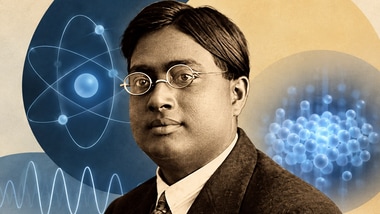
Satyendra Nath Bose was an Indian physicist whose groundbreaking work transformed quantum physics and inspired the name ‘bosons’, a class of fundamental particles. In 1924, he sent a research paper to Albert Einstein, who recognised its importance, translated it into German and helped get it published.
Impressed by his work, Einstein translated it into German and helped get it published. This marked the beginning of a scientific contribution that would leave a lasting impact on modern physics.
Bose’s work laid the foundation for what became known as Bose-Einstein statistics. The class of particles that follows these rules was later named bosons in his honour. Despite his major contribution to science, Bose never received the
Born in Calcutta, now , on 1 January 1894, Bose showed an early interest in mathematics and science. He studied at Presidency College and later became a physics teacher and researcher.
In 1924, while working at the University of , Bose was trying to solve a problem related to the behaviour of light. Scientists had already begun exploring quantum theory, which explains how energy and particles behave at extremely small scales.
Bose developed a new mathematical method to explain Planck’s law of blackbody radiation, which describes how objects emit radiation because of their temperature.
His approach treated light particles, now called photons, as identical and indistinguishable.
When a journal rejected his paper, Bose sent it directly to Einstein. Recognising its importance, translated the paper into German and arranged for its publication in the scientific journal Zeitschrift für Physik.
Einstein later extended Bose’s ideas to atoms, helping develop the theory now known as Bose-Einstein statistics.
Bosons are particles with an integer value of a quantum property called spin. The term was introduced by physicist Paul Dirac in recognition of Bose’s contribution.
Unlike electrons, which belong to another class of particles called fermions, bosons can occupy the same quantum state at the same time. This behaviour helps explain several important phenomena in physics.
Photons, which carry light, are bosons. Other examples include gluons, W and Z bosons, and the Higgs boson, discovered in 2012.
The principles behind bosonic behaviour are important for understanding lasers and several unusual properties of matter. Bose’s work, therefore, continues to influence research across quantum and particle physics.
Einstein used Bose’s statistical approach to predict a remarkable phenomenon: at temperatures extremely close to absolute zero, certain particles could gather in the same lowest-energy quantum state.
This state of matter became known as a Bose-condensate.
In such a condensate, particles behave collectively, allowing scientists to observe quantum effects on a larger scale.
The achievement opened new possibilities for studying quantum behaviour and contributed to further advances in physics.
Bose continued teaching and researching in Dhaka and Calcutta. His interests extended beyond quantum physics to subjects such as X-ray crystallography and other areas of science. He also supported the teaching of science in Bengali to make scientific knowledge more accessible.
In 1954, he received the Padma Vibhushan, one of India’s highest civilian honours. He was elected a Fellow of the Royal Society in 1958 and was appointed National Professor of India.
Despite being nominated for the Nobel Prize several times, Bose never received the award.
Bose died in Calcutta on 4 February 1974, aged 80. Today, his name remains embedded in modern physics through bosons, Bose-Einstein statistics and Bose-Einstein condensates.