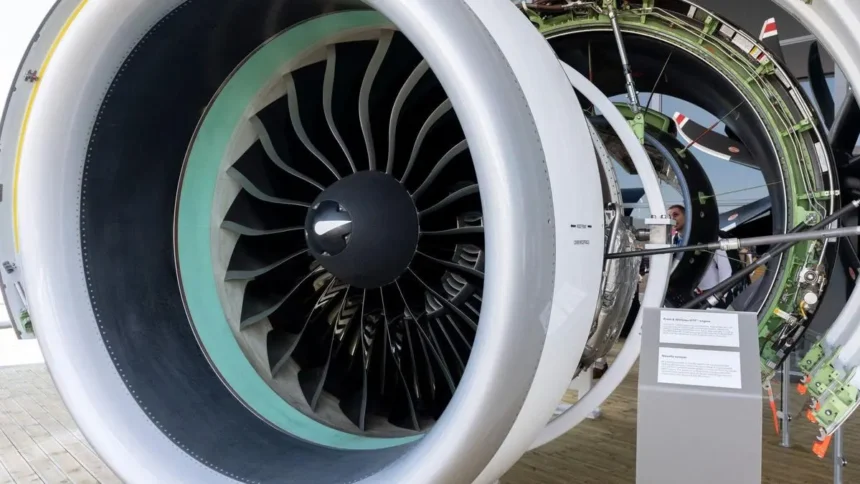
Aircraft engine maker Pratt & Whitney (PW) has signed multi-year supply agreements worth over $40 million with Indian suppliers as it works towards achieving annual sourcing of $150 million from the country by 2030.
Speaking to businessline, Ashish Saraf, Vice President and Country Head, Pratt & Whitney, said these agreements cover suppliers including Bharat Forge, IAMPL, Godrej and Indo MIM.
“Pratt & Whitney is firmly on track to achieve this target,” Saraf said, referring to the company’s sourcing goal for 2030.
The agreements followed a recent supplier event that brought together suppliers and strategic partners to explore opportunities for greater collaboration and capability enhancement.
Accordingly, the aircraft engine maker is looking to expand sourcing across the manufacturing chain, covering raw materials as well as finished components.
“We are looking to source the complete value chain from raw material to finished components. This includes castings, forgings, bars and billets, and getting them machined into finished components,” Saraf said.
Besides expanding volumes, PW is assisting suppliers in developing capabilities in castings, forgings, raw materials and specialised processes related to these categories.
As per available data, PW’s parent company RTX sources more than $500 million in components and services from India annually.
Separately, RTX has invested $240 million in the country over the past five years to establish engineering, operations, training and digital facilities.
On policy support, Saraf sought a sector-specific production-linked incentive (PLI) scheme to encourage the manufacture of high-value aerospace components and localisation of critical supply chains.
The proposed scheme, he said, could follow a phased “crawl-walk-run” approach to support investment and scale.
Other recommendations include support for micro, small and medium enterprises, easier access to capital, technology upgrades, faster certification and regulatory approvals, and improved infrastructure around aerospace manufacturing clusters.
Furthermore, targeted support for research and development, workforce training and industry-academia collaboration would help build domestic capabilities.
However, manufacturing critical engine components requires suppliers to address several challenges simultaneously, including access to specialised materials, advanced manufacturing capabilities, certification requirements, skilled manpower and long investment cycles.
According to Saraf, suppliers often require years of capability development and validation before they can participate in critical aerospace programmes.
In addition, producing an aerospace-grade material or component is only the first step, with extensive testing, validation and certification required before acceptance by a global original equipment manufacturer or integration into its supply chain.
Meanwhile, gaps in these capabilities leave parts of India’s aerospace ecosystem dependent on external sources for critical materials, processes and qualification.
Such dependencies, he said, can expose programmes to geopolitical, logistical and market disruptions, potentially affecting production schedules.
Additionally, the aircraft engine maker continues to evaluate opportunities for developing products in India and increasing local sourcing as domestic suppliers build the capabilities needed to participate more deeply in global aerospace programmes.
Published on October 26, 2026