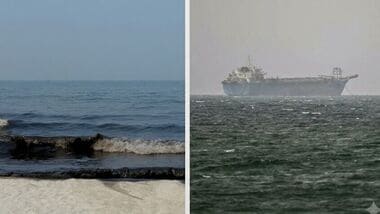
Authorities in Ras Al Khaimah have ordered the closure of all beaches in the emirate until further notice following an offshore oil aleak that also prompted beach closures in neighbouring Umm Al Quwain and Sharjah.
The Public Services Department announced the closures on Saturday in a statement shared by the Ras Al Khaimah Police General Headquarters. Authorities did not specify the reason for the latest restrictions.
The decision came a day after the United Arab Emirates said that efforts were underway to contain oil leaking from a tanker offshore, while the Ministry of Climate Change and Environment conducted an assessment of the potential environmental impact.
The environment ministry said on Friday that all beaches and coastal areas around Umm Al Quwain had been temporarily closed until technical teams completed their assessments and determined the necessary safety and marine protection measures.
The ministry also advised fishermen and other sea users to stay away from affected areas and comply with official instructions.
In neighbouring Sharjah, authorities temporarily closed Al Hamriyah Beach, located on the northern coast near the border with Umm Al Quwain, as a precautionary measure, the Sharjah Government Media Bureau said.
Ras Al Khaimah, one of the northern emirates of the UAE, is known for its beaches and luxury resorts, making the closures significant for coastal activities and tourism.
Residents reported unusual smells in parts of Sharjah, Ajman and Umm Al Quwain following the incident. The UAE’s environment ministry said the odours did not pose a health risk.
However, the smell remained pungent across Umm Al Quwain on Friday, according to reports.
Authorities have not identified the tanker involved in the oil leak or disclosed what caused the spill. The extent of the leakage and its potential impact on marine ecosystems remain unclear as assessments continue.
The incident comes amid heightened concerns about maritime security and environmental damage in Gulf shipping lanes since the start of the US-Israeli war with Iran. Attacks on commercial vessels in the region have raised the risk of further disruption to shipping and potential marine pollution.
In a separate incident in August, a tanker ran aground off Oman’s southeastern coast, leaving the country to deal with an oil slick covering an area approximately six-and-a-half times the size of Manhattan.
Iran also faced an oil spill off Qeshm Island shortly afterwards, near a breeding ground for endangered hawksbill sea turtles.
Earlier this month, a cargo vessel sank in the Strait of Hormuz after a strike triggered a fire, the Maritime and Port Authority of Singapore said.
Commercial vessels struck by projectiles can release fuel into the sea even when their main oil storage tanks remain intact. Such incidents can threaten marine wildlife, damage coastal ecosystems and complicate environmental recovery efforts.
The latest beach closures underscore growing concerns over the environmental consequences of maritime incidents in the region. UAE authorities have yet to provide a timeline for reopening the affected beaches.