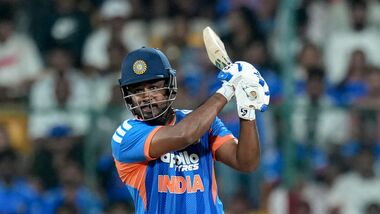
Sanju Samson’s ability to produce match-defining innings has kept him in India’s T20I plans, but competition for batting positions will remain a central selection question as the team prepares for its five-match series against New Zealand, beginning on 22 October.
The wicketkeeper-batter was named in India’s squad for the tour, alongside Ishan Kishan, another wicketkeeping option who can bat in the top order. With Abhishek Sharma, and Tilak Varma also part of the squad, have several options for their batting combination.
’s recent performances against the West Indies illustrated both his capacity to change a game quickly and the fluctuations that have characterised his returns. He scored 11, 82, 3, 56 and 16 across five matches, with the final T20I in Bengaluru being abandoned because of rain.
His 82 off 41 deliveries in Ranchi and 56 off 23 balls in Hyderabad demonstrated his ability to accelerate without needing an extended period at the crease. The two innings also highlighted his value as a top-order batter capable of putting pressure on opposition bowlers during the powerplay and middle overs.
However, the three other scores in that sequence underline the challenge of converting occasional substantial contributions into sustained returns. For a batter competing for a place in a crowded top order, consistency across opportunities remains an important consideration.
India’s selection choices extend beyond Samson’s individual form. The presence of gives the team another wicketkeeper-batter who can operate aggressively at the top of the order, while Abhishek offers a left-handed opening option.
Sooryavanshi’s inclusion adds another contender for an opening position. Tilak, meanwhile, provides a left-handed batting option in the top order and middle order, giving the team flexibility when deciding how to distribute its batting resources.
The competition is therefore not simply a question of which wicketkeeper is in better form. It also involves the balance between right- and left-handed batters, the allocation of opening positions and the need to retain sufficient bowling options.
Samson’s established role as a wicketkeeper-batter gives India flexibility, but his selection does not automatically settle the final playing XI.
The five T20Is will be played across Christchurch, Wellington, Auckland and Hamilton, with the opening two matches scheduled in Christchurch on 22 and 24 October. The remaining fixtures are scheduled for 27 and 30 October and 1 November
The short turnaround from the West Indies series adds another consideration. Samson recently highlighted the limited preparation time available to the Indian team, saying the players would have only one day of batting practice before the opening match in .
Adjusting to the conditions will be important for the entire batting group. Samson’s experience in international cricket could help him assess pitches and bowling attacks quickly, but the series will also provide fresh opportunities for the competing batters to establish their claims.
His performances against the West Indies have given India evidence of his scoring range, particularly when he finds rhythm early in an innings. The next challenge is to carry that output into a different set of conditions.
For Samson, the New Zealand tour presents an opportunity to strengthen his position through substantial contributions at the top of the order.
For India, the selection question is how best to accommodate their available batting options while maintaining a balanced XI. The distinction between Samson’s potential impact and his place in the final combination will remain central to the series.