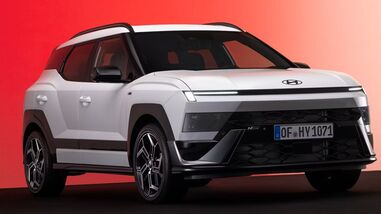
Hyundai Motor Company showcased three key vehicles at the 2026 Paris Motor Show, highlighting its evolving European lineup with the world premiere of the all-new BAYON compact SUV, the European premiere of the new TUCSON and the all-electric STARIA Cargo commercial van.
The showcase also featured the global debut of the TUCSON N Line, which adds sportier styling inspired by Hyundai’s N performance models.
The new BAYON focuses on passenger comfort, connectivity and driver assistance, while the TUCSON combines electrified powertrains with next-generation infotainment technology, including an AI-powered voice assistant. The STARIA Cargo, meanwhile, targets commercial users with a claimed range of up to 450 km and fast-charging capability.
Here are standout features from Hyundai’s latest vehicle showcases.
Hyundai BAYON, TUCSON and STARIA Cargo: Standout features:
– 440-litre boot capacity: Offers 440 litres of luggage space, additional underfloor storage and increased rear legroom, making it practical for families and everyday commuting.
– Dual 12.3-inch curved displays: Available screens enhance the digital cockpit and connected driving experience.
– Advanced smartphone connectivity: Features Hyundai Digital Key 2, wireless Apple CarPlay and Android Auto, and wireless charging.
– Enhanced passenger comfort: Offers heated and ventilated front seats, heated rear seats, reclining rear seats, dedicated rear ventilation and an openable panoramic sunroof.
– New hybrid powertrain planned for 2027: The upcoming 1.6-litre hybrid is projected to deliver 138 PS, with CO₂ emissions starting at 102 g/km.
– Petrol engine options: The initial lineup includes a 1.0-litre T-GDI petrol engine in 90 PS and 115 PS versions.
– Advanced driver assistance: Hyundai SmartSense features include Highway Driving Assist 2, Blind-Spot View Monitor, Forward Collision-Avoidance Assist 2 and Rear Cross-Traffic Collision-Avoidance Assist.
– Sportier BAYON N Line: Gets 18-inch alloy wheels, high-gloss black cladding, a rear diffuser with integrated twin exhaust outlets, and textile-suede seats.
– Electrified powertrain options: The hybrid produces 245 PS and 380 Nm of torque, while the plug-in hybrid delivers 292 PS and 380 Nm.
– Up to 81 km of electric-only range: The plug-in hybrid offers an estimated electric range of up to 81 km with 17-inch wheels, subject to final homologation.
– Bold exterior styling: Hyundai’s Art of Steel design language features muscular fenders, H-Edge lighting and a sculptural Prism Rear Lamp.
– Advanced lighting technology: Optional Micro Pixel Lighting uses 25,600 individual LED pixels for controlled lighting patterns and welcome and farewell animations.
– Spacious cabin and luggage area: Offers up to 695 litres of boot space, alongside generous passenger room and comfort features such as Relaxation seats and optional Ergomotion seats.
– Next-generation infotainment: Pleos Connect, based on Android Automotive OS, offers a 12.9-inch or 17-inch central display, a 9.9-inch driver display and the Gleo AI voice assistant.
– Connected convenience: Features over-the-air software updates, Hyundai Digital Key 2, optional 12-speaker Bang & Olufsen audio and Smart Mood Lamp ambient lighting.
– Fast device charging: Includes two 15W wireless charging pads and four 100W USB-C ports.
– Towing capability: The hybrid can tow up to 1,910 kg, while the plug-in hybrid can tow up to 1,810 kg. Trailer Reverse Assist helps with reversing manoeuvres.
– Sporty TUCSON N Line: The new variant gets 20-inch alloy wheels, a black monotone interior, red accents, textile-suede seats and an N steering wheel with perforated leather grips and red stitching.
– Up to 450 km driving range: The all-electric commercial vehicle offers a claimed WLTP range of up to 450 km.
– 800V charging architecture: Supports charging from 10% to 80% in 20 minutes, helping reduce downtime for commercial operators.
– 218 PS electric motor: Its 160 kW electric motor is designed to deliver responsive performance for business use.
– 1,040 kg payload: Combines a payload capacity of 1,040 kg with space for three Euro pallets.
– 2,000 kg towing capacity: Can tow up to 2,000 kg, including when carrying its maximum payload of 1,040 kg.
– Digital cockpit: Features a 12.3-inch touchscreen and digital instrument cluster through Hyundai’s Connected Car Navigation Cockpit system.
– Remote vehicle management: Connected functions allow users to monitor charging status, manage vehicle functions remotely and control climate settings.
– Vehicle-to-Load functionality: The 3.5 kW V2L system, with external and cargo-area sockets, allows the vehicle to power compatible electrical equipment.
– Driver assistance: Hyundai SmartSense technologies are designed to support safer and more convenient everyday commercial driving.
– Commercial conversion options: Hyundai is working with European upfitting partners to develop configurations tailored to different business requirements.