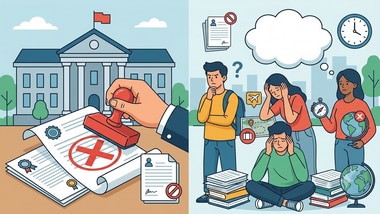
UK universities are reportedly revoking offers en masse made to international applicants, fearing the government’s visa crackdown and subsequent “blanket ban” on recruiting international students.
This comes in response to a doubling in the number of study visas being refused by the Home Office in the first six months of 2026, according to the Financial Times.
According to the report, international students are able to apply for a study visa only after receiving an offer from a university. This would mean that the visa application is withdrawn if the offer is later revoked.
While visa applications can be withdrawn for other reasons, universities were quoted as saying that the main driver had been an increase in the number of offers they revoked.
They told FT this was in response to a doubling in the number of study visas being refused by the Home Office in the first six months of 2026 compared with the same period the year before, which has coincided with a tightening of rules allowing universities to sponsor overseas students.
Institutions where more than 5 per cent of prospective international students given offers subsequently have their visa applications rejected are now at risk of being banned from recruiting them, down from 10 per cent previously, FT reported.
As many as 10.5 per cent of study visa applications to the UK were withdrawn in the first half of this year, the report stated. This was up from 2.3 pewithdrawnr cent in the same period last year and 0.4 per cent in 2023.
Some 40.9 per cent of prospective students from Pakistan had visa applications withdrawn in the first six months of this year, up from 3 per cent in the same period last year, according to FT analysis of Home Office data.
The rise in the Home Office’s rejections of study visas is reportedly driven by a larger increase in refusals from nationalities that the UK government suspects of using the route to make asylum claims.
This has been mirrored by universities withdrawing the offers.
According to figures in the higher education sector, about 15 universities are thought to have suspended recruitment from Pakistan entirely this year.
In addition, 22.7 per cent of study visa applications from Nigeria were withdrawn in the first half of this year, up from 4.5 per cent in the first half of 2025. Bangladesh’s proportion of withdrawn applications rose from 7.1 per cent to 23.5 per cent and India’s from 1.2 per cent to 5.2 per cent.
Data from Enroly, a company that processes visa applicants, suggests that refusal rates at almost half of universities are above the 5 per cent threshold that could result in their being banned from recruiting international students.
Sir David Bell, vice-chancellor of the University of Sunderland, was quoted as saying: “The recent and unexpected spike in visa refusals has prompted pre-emptive action in several universities. This has involved pulling back from international markets where a tougher approach is being taken to visa applications.”
Jamie Arrowsmith, director of Universities UK International, which represents institutions recruiting abroad, acknowledged the need to maintain confidence in the immigration system but said “visa processing has become markedly less predictable”.
“Many refusals appear to rest on flawed, inconsistent and highly subjective reasoning, forcing universities to withdraw offers at scale to avoid breaching compliance thresholds,” he added.
Universities reportedly cited examples of visas rejected because applicants had previously considered studying in other countries or because a PhD applicant could not name course modules, even though they do not exist for such research degrees.
Professor Steven McGuire, deputy vice-chancellor of the University of East Anglia, said the institution began to withdraw offers from certain countries at the end of last year after visa refusals increased markedly.
“We were getting some very arbitrary and ill-informed refusals,” he said. “We had one where the interviewer did not seem to understand that UEA was in Norwich [and so rejected the applicant for not knowing where they were going to study].”
(With inputs from Financial Times)