



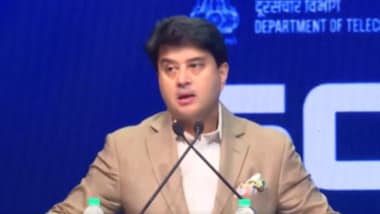
Union Communications Minister Jyotiraditya Scindia said on October 9, 2026, that Starlink, Reliance Jio and OneWeb can begin satellite communication services in India after meeting security requirements and other regulatory conditions. At the India Mobile Congress (IMC) 2026 in New Delhi, Scindia stated that the government will keep the technology neutral and customers will be able to select services in a competitive market.
The minister said that India will not tolerate monopolies and has given all eligible applicants permission to enter this sector as satellite communication operators. Amazon’s Project Kuiper needs to go through the process of obtaining the necessary licences for operations in the country, he added. The government also is in the process of finalising the framework of the revenue charges to be imposed on satellite communication operators.
During the CEO round table on “The Sovereign Inflection & The Future of Telecom”, held at Yashobhoomi during IMC 2026, Scindia stated that the government’s job was to give a predictable regulatory environment and not to favour any particular technology or service provider.
“Government is agnostic. Our job is to provide the bouquet of services. It is for customers to choose in a free market what they prefer,” Scindia said.
He said that a licence does not necessarily enable an operator to commence commercial operations. All companies will have to individually meet the required security measures and other key milestones before they can begin operations.
The minister’s comments come amid satellite internet operators’ plans to increase their footprint in India, where satellite internet might offer connectivity for remote and unserved areas.
According to Scindia, three companies – Jio, OneWeb and – have currently got licences to operate satellite communication services in India. Another potential candidate is Amazon’s Kuiper, which needs to go through the proper procedure.
He said the government would ensure a level playing field while establishing clear rules for the sector. While subject to individual requirements, the revenue charges framework is an important step preceding the implementation of licensed operators.
According to the Department of Telecommunications (DoT), also underscored the country’s strides in telecom coverage, affordability, inclusivity, and innovation in the last ten years during the IMC 2026 CEO round table. Amit Agrawal, Secretary of the DoT, and top industry officials also joined the discussions.
The telecom market is the second largest telecom market in the world and the second largest mobile phone manufacturing hub in the world, Scindia said. He also pointed to the development of the domestic semiconductor manufacturing ecosystem as a step towards building an end-to-end technology supply chain.
The topic of discussion was about artificial intelligence, cloud computing, next-generation networks and indigenous technology development. Scindia highlighted the need for greater collaboration between the government and industry to create resilient digital infrastructure and India’s position as a key player in the global telecom market.