



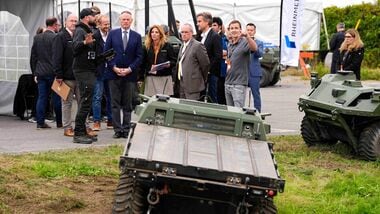
Unmanned ground vehicles (UGVs) are emerging as a critical new element of the Russia-Ukraine war, taking on some of the most dangerous frontline tasks as Ukraine tries to offset manpower shortages and reduce soldiers’ exposure on a battlefield saturated with drones.
units are increasingly deploying four-wheeled and tracked ground robots for combat, logistics, ammunition deliveries and casualty evacuations.
The shift is part of a broader effort to use unmanned systems not just in the air, but increasingly on the ground, as the war stretches into its fifth year.
Reuters reported from a workshop near the frontline in northeastern , where military mechanics were preparing four-wheeled unmanned vehicles known as “Hyenas”.
The robots can carry explosives towards Russian positions and attack enemy dugouts or help halt advancing troops, according to the Reuters report.
The development comes as forces seek to preserve manpower along a roughly 1,200-km frontline.
Brigadier General Andrii Biletskyi, commander of Ukraine’s Third Army Corps, described the gradual replacement of infantry with UGVs as the next “revolution” in warfare, according to Reuters.
His corps aims to replace around one-third of its with unmanned systems by the end of 2026.
Biletskyi said infantry now performs only about 10% of the tasks it carried out before the battlefield became dominated by persistent aerial threats.
UGVs are being used to transport ammunition and food to frontline positions and evacuate wounded soldiers from dangerous areas.
Reuters reported that forces have integrated unmanned ground systems into units across the front as they seek to reduce the risks faced by troops.
Ukraine is also expanding the number and types of ground robotic systems entering military service.
In September, Ukrainian company Air3F’s Varkhan ground robotic system was officially codified and approved for use by the country’s defence forces, according to Kyiv-based news publication Ukrainska Pravda, citing the company.
The four-wheel-drive Varkhan can reportedly carry up to 300 kg of cargo and travel up to 37 km with that load. Its range increases to 50 km without a load, while its maximum speed is 20 km/h.
The company said, as cited in the report, that the system has already been used in combat conditions for frontline logistics missions.
The rise of UGVs follows Ukraine’s rapid development of aerial and maritime drones during the war.
That experience has helped create a close feedback loop between Ukraine’s armed forces and its domestic defence industry. Ukrainian drone makers have developed and modified systems based on battlefield experience, while Russia has simultaneously expanded its own drone capabilities and sought ways to counter
The same dynamic is now moving beyond aerial drones to ground robots.
The growing use of UGVs points to a battlefield where soldiers increasingly operate alongside — and in some roles are replaced by — machines.
UGVs can carry supplies into dangerous areas, evacuate wounded troops and undertake some high-risk combat missions without directly exposing personnel.
But they are not a complete replacement for infantry. Reuters noted that their mobility limitations and production constraints mean human troops will remain essential for many battlefield tasks.
The is therefore becoming a testing ground for a broader model of warfare.
The evolution from drone warfare in the skies to unmanned systems across the battlefield could be one of the most significant lessons emerging from the conflict — and a glimpse of how future land warfare may increasingly be fought.