



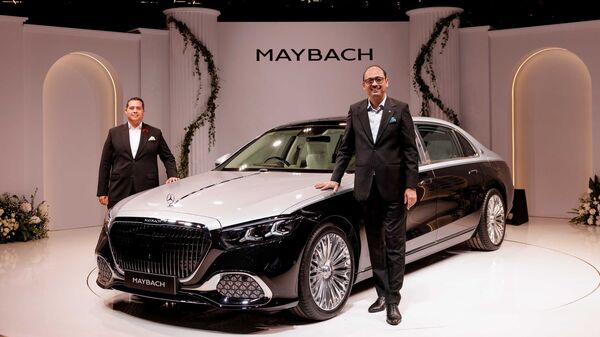
New Delhi: carmakers Mercedes-Benz and BMW are looking to bring global models to India faster, as they seek to narrow the gap between overseas launches and their introduction in India amid rising demand for luxury cars.
The gap between global and India launches has narrowed from about 10-12 months to around 4-6 months, according to the India heads of Mercedes and BMW and a Mint review of their launch announcements.
Mercedes, which is India’s largest luxury carmaker, is set to bring its GLC electric model to the country in November, just six months after sales began in Europe. Mercedes-Benz India managing director and chief executive officer (MD & CEO) Santosh Iyer told Mint that the gap between a global launch and the start of sales in India has narrowed from about 12 months to six months now.
However, he pointed to practical challenges, as some of these cars are left-hand drive, the norm in much of Europe, while India uses right-hand drive, making a faster launch more difficult.
“The wish from sales is fast introduction, but there are practical challenges. Some of these cars have to be shifted from left-hand drive to right-hand drive configurations. So, globally, even for markets like the UK and Australia, it takes three to four months to do the configuration change,” Iyer said.
“And secondly, the next topic is these cars have to be certified and homologated in the local market,” he added.
Homologation is the official approval process through which a testing agency determines whether the car meets a country’s regulatory standards, including safety and emission norms.
Similarly, BMW introduced its new generation of 7 series in India within four months of its Europe launch, highlighting a push from the luxury carmakers to bring their models faster to the world’s third-largest automobile market.
Subhabrata Sengupta, partner at Avalon Consulting, said that shrinking the launch gap has become critical as a big delay can reduce appetite for these products.
“As the market is maturing, Indian consumers are demanding global parity, which has resulted in shortening the gap in launches,” Sengupta said.
The German carmakers’ aggressive portfolio expansion comes at a time when India’s automobile market is seeing strong sales growth, driven by premiumisation—a shift towards higher-priced, feature-rich vehicles. Experts say the trend signals a maturing market.
The trend also underscores India’s rising importance for global , with mass-market manufacturers such as , Renault and Honda identifying the country as a market.
The BMW Group products are making their way to India faster than before, as the country gains importance in the German automaker’s global strategy, BMW India president and chief executive Hardeep Singh Brar told Mint.
“India is the fastest-growing market for BMW worldwide, and our customers increasingly expect access to the newest innovations, technologies and high-performance models at a pace comparable with leading international markets,” said Brar.
He said that BMW has, therefore, shortened the gap between global launches and their India introduction, particularly for its performance models. The average introduction cycle for the M2, M4 and M5, as well as exclusive derivatives such as the M2 CS and M4 CS, is now three to four months from their global launch, Brar said.
“The introduction cycle for these models on an average has been 3-4 months from global launch. Latest example is the highly exclusive Nürburgring Editions with very limited production globally. As Indian consumers are expecting higher luxury and greater exclusivity, we have launched these in India without any delay,” he said.
BMW has also moved to bring some models into local production more quickly. The BMW i7, for instance, is produced locally in India, making the country the only market outside Germany to manufacture the model. Local production followed four months after global production began.
The faster launch cycles come after an aggressive product push by both German luxury carmakers in India. BMW Group India had planned 27 product launches across BMW, MINI and BMW Motorrad in 2026, including 15 under BMW, 10 under MINI and two motorcycles. Mercedes India had announced plans to introduce 12 new models in the country this year.
The faster product rollout comes as luxury carmakers see strong demand in India. Mercedes sold 15,190 vehicles in January-September 2026, its highest-ever sales for the nine-month period in the country, and an 8% increase from 14,132 units a year earlier. Its third-quarter sales rose 6% year-on-year to a record 5,422 units. The company also recorded a 17% quarter-on-quarter increase in sales in the July-September quarter.
Demand for high-end products has been particularly strong, with Mercedes-Benz saying its core luxury segment contributed about 60% of the total sales in the first nine months, while its top-end luxury segment continued to gain traction.
BMW Group India also continued to see strong sales momentum in the first quarter of FY27, with deliveries rising 17% year-on-year to 4,507 cars in April-June. This followed a similar 17% growth in the preceding quarter, taking its first-half calendar-year sales to a record 9,075 units.