



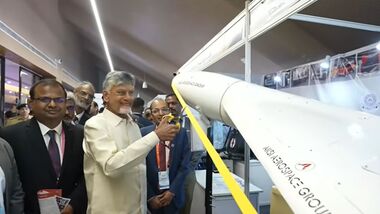
Andhra Pradesh Chief Minister N Chandrababu Naidu on October 3 inaugurated Agni Kalash, a combat drone developed by Hyderabad-based AKSI Aerospace Group, at the PanIIT Andhra Pradesh Summit 2026 in Vijayawada.
The unmanned aerial vehicle (UAV) has been developed by DronAgni Combat Drones Pvt Ltd, a group company of AKSI Aerospace. The company describes Agni Kalash as a long-range platform designed for precision strike missions.
Here is what is known about the drone and its stated capabilities.
Agni Kalash is a long-range combat UAV designed to carry out precision strike missions without putting a human pilot on board.
According to AKSI Aerospace, the drone has a maximum range of up to 300 km and can reach speeds of up to 350 kmph.
The company says the platform has been designed around a modular architecture, allowing it to be configured for different missions and payloads.
The drone has a stated range of up to 300 km.
That puts Agni Kalash in the long-range UAV category and allows it, in principle, to conduct missions considerably farther from its launch point than short-range tactical drones.
The actual operational range of a UAV can depend on factors such as payload, weather, flight profile and mission requirements.
AKSI Aerospace says Agni Kalash can reach a top speed of 350 kmph.
Its combination of range and speed is intended to support missions where the platform needs to travel significant distances while reducing the time required to reach its target area.
A precision-strike UAV is designed to deliver a weapon or other mission payload against a designated target with a high degree of accuracy.
Unlike conventional manned aircraft, a combat drone can conduct a mission without placing a pilot inside the aircraft.
The company has not publicly detailed all the weapons or payloads that Agni Kalash can carry. It has instead highlighted its modular payload architecture, suggesting that different configurations could be used depending on the mission.
One of the notable features claimed by the company is its ability to operate in environments where GPS and GNSS signals are denied.
GPS is the US satellite-navigation system, while GNSS is the broader term for global satellite navigation systems, including GPS and other constellations.
In a conflict, an adversary can attempt to disrupt or jam satellite-navigation signals. A drone capable of continuing its mission in such an environment would therefore have an important operational advantage.
AKSI Aerospace says Agni Kalash incorporates autonomous navigation capabilities for such conditions.
The company also describes Agni Kalash as networked and swarm-capable.
A drone swarm refers to multiple unmanned platforms operating in a coordinated manner, potentially sharing information and carrying out tasks collectively.
Swarm-capable systems can allow several drones to be deployed as part of a coordinated operation rather than treating every aircraft as an isolated platform.
However, the company has not disclosed detailed operational information about how Agni Kalash’s swarm capability works.
AKSI Aerospace says Agni Kalash has a low-observable airframe.
In simple terms, low observability refers to design features intended to make a platform harder to detect or track by an adversary’s sensors.
The term does not necessarily mean that a drone is invisible or undetectable. Its effectiveness depends on the sensors and defensive systems being used against it.
AKSI Aerospace says the drone uses indigenous technologies in several critical systems.
These include:
Engine
Avionics
Battery systems
Airframe
The company says its objective is to develop a larger Indian aerospace and unmanned-systems manufacturing ecosystem rather than simply produce an individual drone platform.
During his visit to the company’s pavilion at the PanIIT Andhra Pradesh Summit, Naidu was briefed by Pankaj Akula, group managing director and founder MD and chief technologist of AKSI Aerospace.
Akula said the company wants Andhra Pradesh to emerge as a major hub for drones, unmanned systems, aircraft components, propulsion systems, batteries, autopilots, advanced composites and precision aerospace manufacturing.
He also outlined a manufacturing model extending beyond a single industrial facility, involving distributed manufacturing capabilities, supplier networks, skill centres and employment opportunities across districts.
The company’s stated objective is summed up in its slogan: “Design in India. Develop in India. Manufacture in India. Scale from Andhra Pradesh to the World.”
Agni Kalash comes as India is placing greater emphasis on indigenous drones, unmanned systems and defence manufacturing.
Combat UAVs can provide militaries with surveillance, reconnaissance and strike capabilities while reducing the risks to personnel. Technologies such as autonomous navigation, operation in GPS-denied environments and networked operations are also increasingly important as modern battlefields become more contested and electronic warfare becomes more prominent.
For Andhra Pradesh, the development also fits into a broader industrial ambition: building a local ecosystem around drone manufacturing and related technologies.