


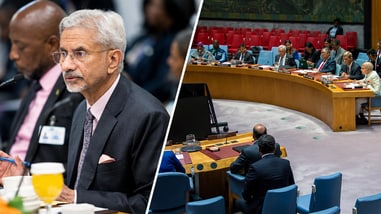
External Affairs Minister S Jaishankar has delivered a blunt assessment of the United Nations, saying the world body has become “largely irrelevant” to decision-making on some of the biggest global crises because of a “gridlocked” UN Security Council.
Speaking at the 5th Kautilya Economic Conclave in New Delhi on Monday, Jaishankar said the UN’s inability to respond effectively to major conflicts and global crises had exposed the limitations of its current structure, according to news agency ANI.
“Where the UN is concerned, it’s obvious to everybody by now that the UN is gridlocked,” said, pointing to conflicts in the Gulf, Ukraine and Africa, as well as the pandemic.
He said the problem was closely linked to the structure of the whose composition, he said, no longer reflects the wider international community.
“And a lot of it is because the Security Council is gridlocked and the Security Council no longer represents the entirety of the global interest,” he said.
The UN Security Council is the United Nations’ principal body for dealing with international peace and security. It has 15 members — five permanent members with veto powers and 10 elected members.
The permanent members — the United States, Russia, China, France and the UK — can block substantive resolutions through their veto.
The structure has increasingly come under scrutiny as major powers have found themselves divided over conflicts, including the war in Ukraine and crises in the
Jaishankar argued that the institution has failed to keep pace with the dramatic expansion of the membership.
“The UN started with 51 members; it’s got almost four times that number today. So, if you have grown four times and you want to keep the old board of management, it’s not going to work. It’s common sense,” he said.
For India, the issue is not simply about securing a permanent seat on the UN Security Council. has argued that the Council itself needs to become more representative of the geopolitical realities of the 21st century.
When the UN was founded in 1945, much of Asia and Africa was still under colonial rule. Today, developing countries account for a large share of UN membership, but their representation in the Council’s permanent structure remains limited.
India has therefore pushed for an expansion of both permanent and non-permanent membership, along with greater representation for Africa.
In an earlier interview with LiveMint, former diplomat Suresh Goel, who served at the Permanent Mission of India to the United Nations in New York from 1991-95, explained why India’s case for permanent membership goes beyond its own national interests.
“The question is not why it is important for India to have a permanent seat on the UN Security Council, but why the world needs India as a permanent member,” Goel said.
“India’s claim to permanent membership is therefore also based on its role as a voice of the Global South,” he added.
New Delhi has been working with the G4 grouping — India, Brazil, Germany and Japan — as well as the L.69 Group, a cross-regional coalition of developing countries, to build support for UNSC reform.
Jaishankar also took aim at countries that, he said, invoke Africa’s interests while opposing reforms to the UN.
“There are a few players, a few countries who are resistant to the reform of the UN, and they are using the name of Africa,” he said.
According to , African countries have already articulated their position on reform through the intergovernmental negotiations.
India has repeatedly backed greater representation, arguing that a reformed Security Council must better reflect the interests of the Global South.
Jaishankar’s remarks come as the campaign for Security Council reform gains fresh momentum during the ongoing UN General Assembly session.
The — India, Brazil, Germany and Japan — recently renewed its call for reform, describing the current structure of the eight-decade-old Security Council as “anachronistic” and arguing that reform is “more necessary than ever” amid growing global challenges.
The grouping also reiterated its support for greater representation of African countries on the
Separately, the four members of the Visegrad Group — Hungary, Poland, Slovakia and the Czech Republic — have voiced collective support for UNSC reform.
(With inputs from ANI)