



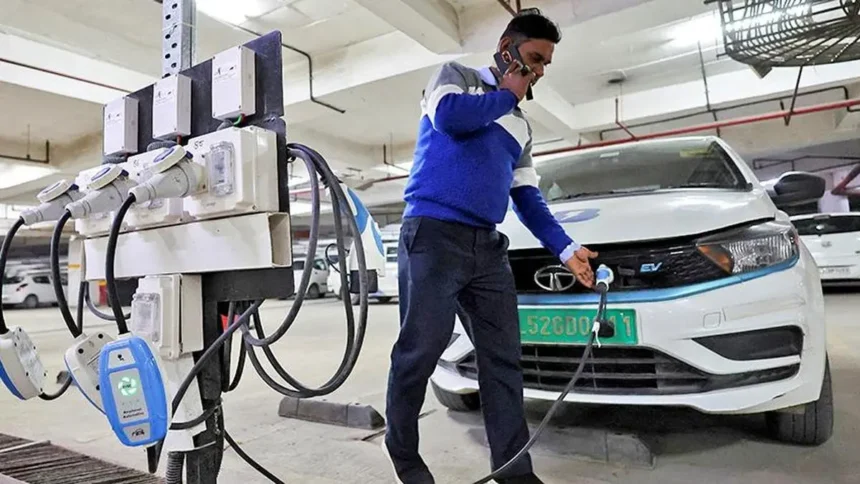
Battery-as-a-Service (BaaS), which still accounts for only an estimated 4-6 per cent of India’s electric-car sales, is emerging as a new battleground in the EV market after Tata Motors expanded the model across its portfolio. The move brings sharper competition among Tata, Mahindra, MG Motor, Maruti Suzuki and Hyundai by significantly lowering advertised vehicle prices through separate battery financing.
Under BaaS, EVs traditionally priced around ₹19 lakh can now be marketed at nearly ₹11-14 lakh. Tata’s Sierra.ev, for instance, is available at ₹11.99 lakh under BaaS compared with ₹18.79 lakh with the battery included. Mahindra’s BE 6 Sporteq is priced at ₹11.45 lakh versus ₹19.45 lakh, while MG’s Hector Tomahawk EV is being offered at ₹13.99 lakh against a conventional price of around ₹19.50 lakh.
The model’s current penetration remains modest, but its potential is significant. At JSW MG Motor India, which introduced BaaS with the Windsor EV, the financing model is estimated to contribute 12-15 per cent of EV sales. Tata has now expanded BaaS across six EVs, creating an advertised price band ranging from ₹4.69 lakh to ₹14.49 lakh.
A closer look at battery-financing rates changes the picture. Mahindra quotes an effective battery-financing cost of ₹3.75 per kilometre for the 59-kWh BE 6 Sporteq. This compares with Rs 5.50 per kilometre for Tata’s 63-kWh Sierra.ev and ₹4.90 per kilometre for MG’s 69.2-kWh Tomahawk.
On advertised metrics, Mahindra offers both the lowest entry price and the cheapest quoted battery-financing rate among the three contenders. However, comparisons are not entirely like-for-like because battery capacities, specifications and financing structures differ.
Competition is equally intense in the mid-market segment. Maruti Suzuki’s e Vitara, Tata’s Curvv.ev and Hyundai’s Creta Electric can all be presented at an identical advertised vehicle price of ₹10.99 lakh under BaaS.
Yet financing costs vary. Hyundai quotes ₹3.90 per kilometre, Maruti Suzuki ₹3.99 per kilometre and Tata ₹5 per kilometre. Similar showroom prices therefore conceal meaningful differences in battery size and ownership costs.
The battle extends further down the market. Kia’s Syros EV starts at ₹7.99 lakh under BaaS, Tata’s Nexon.ev at ₹8.99 lakh and MG’s Windsor at ₹9.99 lakh. At the entry level, Tata’s Tiago.ev is priced at ₹4.69 lakh, MG’s Comet EV at ₹4.99 lakh, Tata’s Punch.ev at ₹6.59 lakh and Citroen’s e-C3X Extended at ₹6.99 lakh.
Tata’s expansion has effectively created a parallel EV price ladder by moving one of the vehicle’s costliest components out of the upfront purchase price and into a separate financing obligation.
“As BaaS becomes an increasingly visible construct in the EV market, we want to ensure that customers evaluating a TATA.ev have complete flexibility to make a fair and transparent comparison,” said Vivek Srivatsa, chief commercial officer, Tata Motors Passenger Vehicles.
The key caveat is that the battery is not free. Buyers must still account for battery EMIs, which vary by battery size, down payment and tenure. Charging and on-road costs remain additional expenses.
For now, Mahindra leads on advertised affordability in the ₹19-lakh segment, Tata has the broadest BaaS lineup, and Maruti has turned the ₹10.99 lakh bracket into a fiercely contested category. For consumers, the sticker price may be attractive, but the real cost calculation starts after the showroom floor.
Published on October 2, 2026