


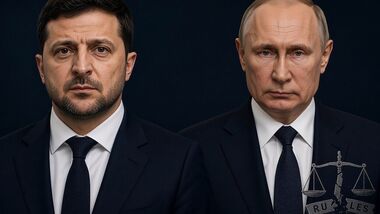
Ukrainian President Volodymyr Zelensky has claimed that Russian President Vladimir Putin instructed his military leaders in September to abandon restrictions that had governed previous Russian air campaigns, citing intelligence intercepted by Kyiv.
Speaking to the Financial Times from a bomb shelter inside a Kyiv school that had just been struck by a Russian jet-powered drone, Zelensky said Ukrainian intelligence had obtained intercepted communications involving Kremlin officials.
“He said there are no rules now,” Zelenskyy told the FT, referring to the intelligence.
According to the Ukrainian president, the alleged change came as Russia intensified its aerial attacks on Kyiv and other Ukrainian cities, with strikes hitting schools, hospitals, data centres and other infrastructure. The claim could not be independently verified. The Kremlin has denied deliberately targeting schools and hospitals.
Zelensky told the news outlet that Russia was preparing to intensify attacks on Ukraine’s largest cities ahead of winter, with the reported aim of isolating them from the rest of the country.
Kyiv, Kharkiv and Odesa were identified as the main targets in a Ukrainian intelligence assessment described to the news outlet by Ukrainian and European officials. Lviv, a major logistics hub near the Polish border, was also cited by officials familiar with the intelligence.
Ukrainian officials further claimed that Moscow could seek to disrupt nuclear facilities and disconnect them from the power grid. They said another potential objective was to trigger a fresh refugee flow into the European Union, increasing pressure on countries already dealing with migration concerns.
Zelensky said Russia’s aerial campaign was intended not merely to destroy infrastructure but also “to pressure people” and create fear through sustained bombardment.
The Ukrainian president said that earlier in the war, Moscow had largely focused on energy and military facilities. He now claimed Russian drones were increasingly striking schools, telecommunications hubs and data centres.
The FT reported that a Russian drone struck Ukraine’s National Academy of Sciences in central Kyiv on Monday. Around the time of Thursday’s school strike, drones also hit one of Kyiv’s main bridges.
Kremlin spokesperson Dmitry Peskov rejected the allegation that Russia targets schools and hospitals, saying: “Russia’s armed forces do not strike schools or hospitals.” The FT also reported that debris recovered from the school strike contained markings associated with Russian manufacturers.
Ukraine’s education ministry has documented more than 4,700 attacks on educational institutions, while the World Health Organization has verified strikes on more than 3,000 healthcare facilities since Russia’s full-scale invasion began in 2022, according to the FT.
The escalation comes as Russia has increasingly deployed faster, jet-powered drones that are more difficult for Ukrainian air defences to intercept.
Zelenskyy told the FT that Russia had launched about 500 drones in a single day, with roughly half being jet-powered. He said Ukraine was destroying about 57% of the jet-powered drones and between 85% and 90% of conventional drones.
Ukraine is responding by developing high-speed interceptor drones. Zelenskyy said five interceptor models were being tested and that Ukraine expected to produce around 400 units of one model by the end of October.
But the programme faces shortages of engines and funding. “Engines [are] the key,” Zelensky said, adding that Ukraine imports many of the engines needed for the interceptors.
Zelensky also said US-made F-16 fighter jets had proved effective against Russia’s new jet-powered drones, but claimed that around half of Ukraine’s F-16 fleet was spending extended periods in Europe for repairs and maintenance.
He called for more maintenance work to be moved inside Ukraine, arguing that this would allow aircraft to return to service faster and strengthen the country’s air defence.
The Ukrainian president also criticised Western governments for what he described as insufficient political and economic pressure on Moscow.
Asked by the FT whether Ukraine’s partners were doing everything possible to support Kyiv, Zelensky replied: “Not enough, of course not enough.”