



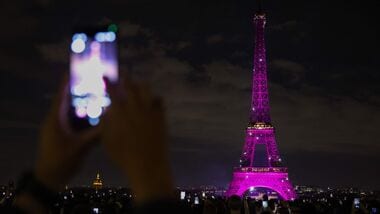
As October began, the Parisian night sky was transformed by a striking visual display: the Eiffel Tower, one of the world’s most recognisable landmarks, illuminated in a vibrant shade of pink.
Crowds of onlookers gathered, capturing the breathtaking sight on their phones, AFP shared in a social media post.
However, the dazzling pink illumination is not merely a decorative light show. It marks the official launch of “Octobre Rose,” or Pink October—the annual international health campaign dedicated to raising awareness about .
Pink October is the global name for , an annual international health campaign observed throughout the month of October. The name is derived from the pink ribbon, which serves as the universal symbol of breast cancer awareness, solidarity, and support.
According to AFP, the initiative has three primary objectives: to raise public awareness about the disease, to strongly promote early detection, and to raise crucial funds for ongoing medical research.
The pink ribbon and the corresponding pink lights have become the universal symbols of this global movement. They represent solidarity with those currently battling the disease, celebrate the resilience of survivors, and honour the memory of those who have lost their lives to breast cancer.
A central pillar of the Pink October campaign, and the primary reason high-profile landmarks like the are used to grab global attention, is the promotion of early detection.
Medical experts universally believe that diagnosing breast cancer in its earliest, most localised stages drastically improves a patient’s chances of successful treatment and long-term survival.
Throughout the month, health organisations run intensive educational campaigns encouraging individuals to perform regular breast self-examinations and schedule routine clinical screenings, such as mammograms.
By sparking conversations and turning public spaces pink, the campaign actively works to dismantle the stigma and fear that often deter individuals from seeking preventive healthcare.
Beyond awareness, Pink October serves as a massive economic engine for scientific research. The global attention generated by illuminated monuments and viral smartphone footage translates directly into fundraising power.
Charities and medical institutions leverage this month to raise capital vital to researching more accurate diagnostic tools, developing less invasive and more effective treatments, and ultimately working toward a definitive cure.