


posted 405/7 in the second ODI at Barsapara Stadium on Wednesday. India need 406 to win. That is the largest target the Men in Blue have ever faced in a men’s one-day international.
It would not quite be the biggest successful chase in world cricket. South Africa’s 438 for 9 against Australia in Johannesburg in 2006 remains the record. A finish of 406, though, would lift India to second on the all-time list, make them only the second side after South Africa to chase 400-plus, and erase their own mark of 362 for 1 against Australia in Jaipur in 20
won the toss and chose to bowl. John Campbell (101 off 68), captain Shai Hope (104) and Amir Jangoo (114 off 77) then became the first West Indies trio to score hundreds in the same ODI innings. It was only the sixth such instance in the format. West Indies’ previous best was 389 against England in 2019. Kuldeep Yadav also reached 200 ODI wickets.
India already lead the series 1-0 after chasing 296 in Thiruvananthapuram, where Gill made 110 and an unbeaten 139.
India’s highest successful ODI chase is still that night in Jaipur. Australia made 359. India replied with 362/1. Shikhar Dhawan scored 95, Rohit Sharma finished on 141 not out, and Kohli struck a then-fastest Indian ODI hundred off 52 balls. Completing 406 in Guwahati would raise that 13-year-old record by 44 runs.
The reply has already produced landmarks. Rohit scored 101 off 75 and became only the third Indian after and Kohli to reach 12,000 ODI runs. It was his 35th hundred in the format. He fell LBW to Jayden Seales at 255/1.
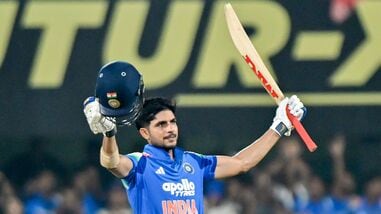
Shubman Gill, on the other hand, reached his 11th ODI hundred off 62 balls, the fastest by an Indian captain, beating Rohit’s 63-ball century against Afghanistan at the 2023 World Cup. He later brought up 150 off 89 balls, India’s fastest in ODIs. India also became the fastest team to 300 in an ODI, in 29.1 overs.
Set a new national record for a successful ODI chase, beating 362
Become only the second team in men’s ODIs to chase 400 or more
Move to second on the all-time successful chase list behind South Africa’s 438