


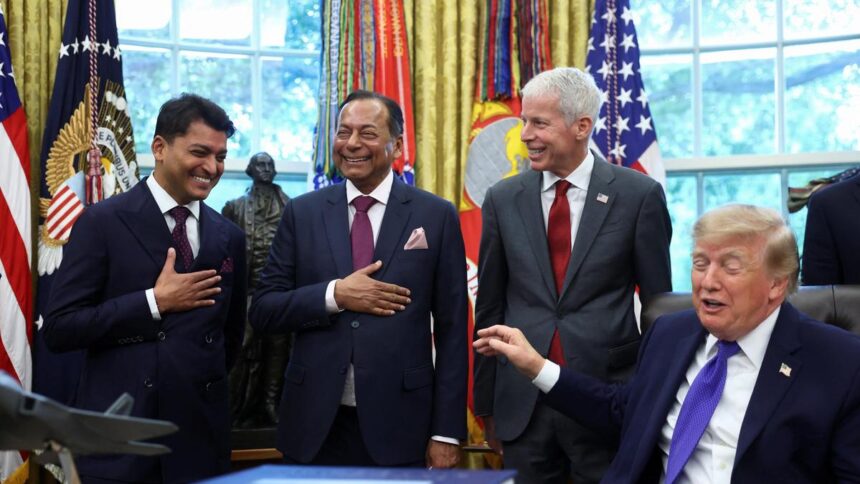
US President Donald Trump terming Essar-backed Mesabi Metallics’ $18-billion Iowa bet as the “largest steel plant in American history,” narrates the once debt-laden conglomerate’s over decade-long deleveraging and portfolio-restructuring exercise to create a business focussed on a sustainable capital structure, geography, and technology.
The integrated iron ore mining-to-finished steel push for the Group — controlled by the Ruia family — is in many ways a comeback to its past core expertise in steel and energy, but with an asset light model and a new business strategy.
For instance, Essar purchased $260 million face value notes issued by Mesabi Metallics in 2019, paving the way for Essar Global to once again participate in the low-cost iron ore mining and pellet manufacturing project in Minnesota, the US.
Ironically, it was the steel plant in Hazira that triggered Essar’s bankruptcy woes. Now, it is betting on integrated steel projects such as the one in the US to script a turnaround.
The Ruia family, with Prashant Ruia in the driver’s seat, now prefer to be smart investors rather than promoters, a clear indication that the focus has shifted from a family-owned business to an eye on returns and shareholder interest. It has repaid more than ₹1,37,000 crore ($21 billion) of debt.
The Essar group of the past was asset heavy, with total ownership of all the infrastructure in its portfolio. It still has assets, but it is executing them with partners. What Essar brings to the table in many of its projects is its expertise, skills, and experience in the sectors, says a company insider.
For instance, in February 2023, the group announced a $3.6-billion investment by Essar Energy Transition in low carbon energy transition projects. This investment will be done over a period of five years and, more importantly, it will take on a partner who will provide a considerable portion of the equity.
Another important element is risk mitigation becoming a key strategy. Accordingly, it has de-risked operations by spreading them across India, the UK, the US, Vietnam, and Saudi Arabia. There is a clear focus on spreading steel assets across India, West Asia and the US, while the retail fuel business and low carbon economy is being expanded in the UK.
Energy was the focus of the old Essar, and it remains so. “We’ve been involved in the energy sector for the last 30 years… the idea is to remain focused on energy,” Prashant Ruia had told businessline in 2023.
The difference is in technologies, with the earlier focus on energy through refineries, exploration, production, downstream and retail — in effect the entire value chain. The theme has now changed to decarbonisation, investing in innovative technologies to deliver green and clean energies through renewable sources.
“The idea is to remain focused on the value chain, but with future technologies,” Ruia had emphasised then.
Essar is now poised to leverage these new assets with the latest, more efficient, and ESG-compliant technologies to last the next several decades.
The main assets under energy include a 10 million tonnes per annum (MTPA) refinery in the UK, 15 trillion cubic feet of reserves (including some producing fields) of unconventional hydrocarbons in India and Vietnam, and a 1,200 MW power plant in India.
Infrastructure assets include a storage terminal in the UK of 3 million cubic meters capacity and a 20 MTPA port in India. The metals and mining assets include a major iron ore mine and a pellet project in the US and Saudi Arabia.
Published on September 30, 2026