


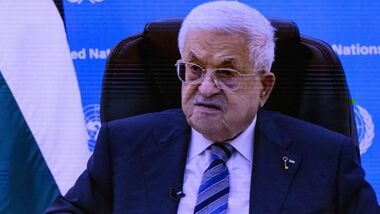
Palestinian President Mahmoud Abbas used his address to the 81st United Nations General Assembly on Thursday (September 24), to warn that Israeli policies were threatening not only the prospects of a two-state solution but the continued presence of Palestinians on their land.
Abbas delivered the address through a pre-recorded video from Ramallah after the United States denied him a visa to attend the UN gathering in New York. The UN General Assembly had earlier approved a mechanism allowing him to address the assembly virtually.
Here are the key takeaways from Abbas’ UNGA address:
Abbas said the danger facing Palestinians had gone beyond the erosion of prospects for a two-state solution.
“The danger is no longer limited to undermining the two-state solution and preventing the realization of the Palestinian state. It has now come to threaten the very life and existence of the Palestinian people on their homeland.”
He warned that Israeli settlement expansion in the occupied West Bank, including East Jerusalem, was fragmenting Palestinian territory.
Abbas criticised Washington for denying him a visa to attend the UN General Assembly, calling the measures “unlawful punitive measures”.
“We reject these unlawful punitive measures, as well as the accusations and justifications on which they were based.”
The US has previously cited Palestinian efforts to internationalise the Israeli-Palestinian conflict and actions involving international tribunals as reasons for visa restrictions on Abbas and other Palestinian officials.
Abbas called on Washington to lift the measures, resume dialogue with the Palestinian leadership and support international efforts to implement a two-state solution.
His appeal comes as the US continues to play a central role in efforts to shape the future political arrangements involving Israel and the Palestinians.
Abbas accused Israel of using settlement expansion to fragment Palestinian territory.
He said the expansion was aimed at separating the northern West Bank from the south and isolating East Jerusalem from its Palestinian surroundings.
“This requires urgent and responsible intervention by the United Nations Security Council.”
The UN secretary-general has also warned that settlement expansion and violence in the occupied West Bank are undermining prospects for a viable Palestinian state.
Abbas said 160 countries had recognised the State of Palestine and urged other countries to follow suit.
He argued that international recognition should be accompanied by action to preserve the territory on which a Palestinian state would be established.
“Saving the solution begins with preserving the land on which the Palestinian state is to be established and protecting the people who live on it.”
Abbas said developments in Gaza, the West Bank and East Jerusalem should not be viewed as separate issues.
“What is taking place in Gaza, the West Bank, and East Jerusalem are not isolated incidents…”
Abbas announced that Palestinians were moving toward legislative elections on November 28, followed by the renewal of institutions of the Palestinian National Council and eventually presidential elections.
He said: “We have completed the national reform program to which we committed ourselves before our people and the international community.”
The planned November vote would be the first Palestinian legislative election in two decades.