



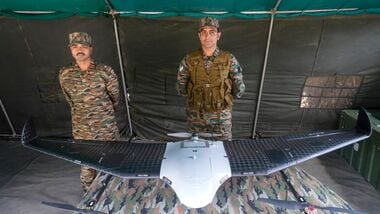
An Indian firm and an American defence major on Tuesday announced a collaboration to support the development of India’s high-altitude, long-endurance (HALE) unmanned aerial vehicle (UAV), news agency PTI reported.
Bharat Forge and Pratt & Whitney Canada said in a joint statement that they will evaluate the integration of advanced turboprop engines into a HALE UAV being designed and developed under a Defence Research and Development Organisation () programme.
The collaboration brings together Pratt & Whitney Canada’s propulsion technology and Bharat Forge’s engineering and systems integration capabilities as India seeks to expand its indigenous ecosystem.
India’s unmanned aerial vehicle programme is expanding towards indigenous development, heavy-payload logistics and advanced strike capabilities under the Aatmanirbhar Bharat initiative.
The Bharat Forge-Pratt & Whitney Canada partnership is focused on one of the critical elements of a HALE platform: propulsion. The evaluation of advanced turboprop engines could support the development of a long-endurance platform designed for sustained operations at high altitude.
“Bharat Forge Aerospace business is proud to collaborate with Pratt & Whitney Canada to advance India’s indigenous aerospace and defence manufacturing capabilities,” Amit Kalyani, Vice Chairman and Joint Managing Director of Bharat Forge Ltd., was quoted as saying by PTI.
“By combining Pratt & Whitney’s globally proven propulsion technologies with Bharat Forge’s engineering and systems integration expertise, we aim to support development of a world-class HALE platform that strengthens India’s strategic self-reliance and defence preparedness,” he said.
Ashish Saraf, Vice President and Country Head, Pratt & Whitney, said the collaboration reflects the company’s continued commitment to supporting India’s aerospace and defence ambitions.
“Pratt & Whitney Canada’s turboprop engines have a proven legacy of reliability in demanding operational environments, which is exactly what’s needed for India’s HALE programme,” he said, as per PTI.
The collaboration comes as India seeks to build a larger indigenous drone manufacturing ecosystem and reduce its reliance on imports.
India is also moving towards greater domestic production through initiatives such as a ₹1,577 crore contract involving Tata Advanced Systems and NIBE, as well as a planned military drone procurement worth more than $2 billion from domestic firms.
India is increasingly viewing drones as an integral part of its defence strategy, with recent conflicts highlighting their use in reconnaissance, strike operations, logistics and counter-drone missions, according to think tank Sphrical Insights.
The expansion is also reflected in the growing number of companies operating in the sector. According to the think tank, India now has more than 600 drone-related companies, including over 100 defence-focused firms, creating a larger industrial base for military UAVs, components and related technologies.
Earlier this year, in March, Defence Minister said India must work in mission mode to emerge as a global hub for indigenous drone manufacturing in the coming years.
Addressing the National Defence Industries Conclave in New Delhi, Singh stressed the need to build a drone production ecosystem to ensure strategic autonomy, enhance defence preparedness and make the country amid geopolitical uncertainties.
The push for high-altitude, long-endurance drones has gained importance following prolonged military standoffs along the Line of Actual Control (LAC) with China.
HALE platforms can provide persistent, high-resolution surveillance over mountainous terrain, making them relevant for monitoring difficult and remote areas.
India is also looking at unmanned systems for logistics. The Ministry of Defence (MoD) has issued a Request for Information (RFI) to procure 2,715 logistics drones for the Indian Army.
If the proposal moves forward, it would be the Army’s largest-ever procurement of logistics drones and could mark a significant expansion in the use of unmanned systems for military supply operations.
Recent military operations and conflicts have also shaped the expanding focus on UAVs.
Unmanned aerial vehicles played a foundational role in Operation Sindoor, India’s tri-service military response launched on May 7, 2025, following the Pahalgam terror attack.
Pakistan used drones targeting Indian cities, which were effectively neutralised.
India, meanwhile, used kamikaze and suicide drones, including Harpy, Harop and Sky Striker platforms, to hit tactical positions, aircraft hangars and radar sites, according to a Press Information Bureau (PIB) release.
The release said loitering munitions were used to target high-value assets, including enemy radar and missile systems.
In August 2026, India signed a $203 million, 30-month agreement with General Atomics to lease two MQ-9B Sea Guardian drones for the Indian Navy’s maritime surveillance operations.
The government said the deal would “significantly enhance” the Indian Navy’s maritime domain awareness capabilities and strengthen its “ability to monitor and respond to developments across the Indian Ocean Region”.
The agreement comes at a time when India and China are engaged in a strategic tussle for influence in the Indian Ocean region.
Against this backdrop, the Bharat Forge-Pratt & Whitney Canada collaboration on the DRDO’s HALE UAV programme represents another step in India’s expanding unmanned systems ecosystem.
While the immediate focus is on evaluating propulsion integration, the programme comes amid a broader push to develop indigenous capabilities for drone production.