



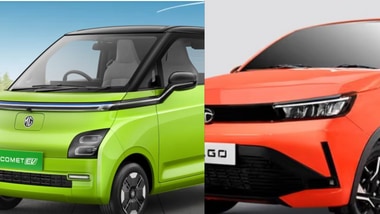
Looking for an electric vehicle (EV) under ₹10 lakh? Buyers in India now have several mass-market options to choose from, including the MG Comet EV and Tata Tiago EV. With claimed ranges of up to 350 km, these models make electric mobility more accessible to budget-conscious buyers.
The availability of fully electric cars below the ₹10 lakh mark also signals a shift in the Indian automobile market, where buyers can increasingly choose between electric and petrol-powered vehicles without paying a significant premium for an EV.
The MG Comet EV takes a different approach to affordable electric mobility with its ultra-compact dimensions. At 2,974mm long, it is around 500mm shorter than the Maruti Alto. Despite its small footprint, the tall-boy design offers enough cabin space for four adults.
The Comet EV also has a 5.6-metre turning radius, making it particularly suited to navigating congested city roads and tight parking spaces. Priced from around ₹7.80 lakh, it offers a claimed range of up to 230 km, making it an option for buyers seeking an affordable urban EV.
The offers a more conventional hatchback experience for buyers looking to make the switch to electric mobility. It is available with two battery options: a 19.2kWh battery with a claimed ARAI range of 250 km and a 24kWh battery with a claimed range of 293 km.
The Long Range (LR) version also gets DC fast charging, allowing the battery to charge from 10% to 80% in around 57 minutes. Other features include cruise control, automatic climate control and rear disc brakes.
With the LR variant priced at around ₹9.49 lakh, it remains within the ₹10 lakh budget while offering a longer range and additional features for buyers looking for a practical electric hatchback.
For buyers looking for a larger electric vehicle than the Comet or Tiago, the Tata Punch EV offers a more SUV-like package. It starts at around ₹9.79 lakh and has a claimed range of between 275 km and 350 km, depending on the variant.
The Punch EV combines the higher seating position and styling associated with an SUV with an all-electric powertrain, making it one of the options for buyers seeking an EV below the ₹10 lakh mark.
Meanwhile, Maruti Suzuki India Ltd, the country’s largest carmaker, has commenced production at a new manufacturing plant at its Hansalpur facility in Gujarat. The additional capacity is expected to ease supply constraints that have affected the availability of its first electric vehicle, the eVitara, in the domestic market.
The new plant was built with an investment of ₹3,900 crore and has an annual production capacity of 250,000 EVs, taking the overall capacity at the Hansalpur facility to 1 million units. Maruti Suzuki’s combined annual manufacturing capacity across its four plants has now increased to 2.9 million vehicles, as the company works towards its target of reaching 4 million units by 2030.
The company currently manufactures vehicles across four facilities — Hansalpur in Gujarat, its only plant producing EVs, and Gurugram, Kharkhoda and Manesar in Haryana.
Meanwhile, India’s largest carmaker, as it looks to strengthen its presence in the growing EV market. The company has started production at a new plant at its Hansalpur facility in Gujarat, helping ease capacity constraints that had limited supplies of its first EV, the eVitara, in the domestic market.
Built at an investment of ₹3,900 crore, the new plant has an annual capacity to produce 250,000 EVs, taking the total capacity of the Hansalpur facility to 1 million units. Maruti Suzuki’s overall annual manufacturing capacity across its four plants has now reached 2.9 million vehicles, with the company targeting 4 million units by 2030.