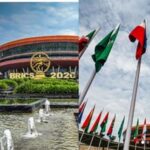



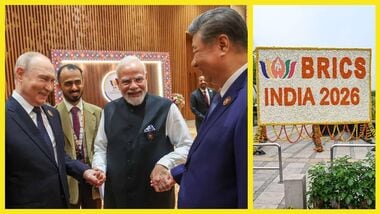
BRICS Summit: Prime Minister Narendra Modi on Saturday announced the unanimous adoption of the at the 18th BRICS Summit being held in the national capital.
“No member has raised any objection. The New Delhi Declaration 2026 is adopted unanimously,” PM Modi said at the Summit.
The joint declaration stressed the need to engage in conflict prevention efforts, including through addressing their root causes. It also reiterated the BRICS nations’ commitment to peaceful resolution of international disputes through dialogue, consultation and diplomacy.
The declaration advocated for a multilateral approach that respects diverse national viewpoints and positions on crucial global issues. The joint statement voiced serious concerns about rise of unilateral tariff, non-tariff measures which distort trade, are inconsistent with WTO rules.
BRICS countries reached the consensus on a Joint Statement after intensive negotiations that continued until wee hours on Saturday. The negotiations saw differences on several contentious issues. India led sustained consultations to bridge competing positions and build consensus among members.
The breakthrough assumes particular significance given that Iran, Saudi Arabia, and the UAE are all part of the same forum, despite deep differences and competing positions on several regional and geopolitical issues.
Against the backdrop of ongoing conflicts and heightened tensions in West Asia, securing consensus among countries such as Iran, Saudi Arabia, and the UAE presented a particularly complex diplomatic challenge. India’s diplomatic prowess ensured that these differences did not derail the BRICS process, paving the way for a consensus Joint Statement despite sharply divergent geopolitical positions among member countries.
The adoption of the 140-point declaratin came as India is hosting the 18th BRICS Summit in New Delhi with India’s Chairship guided by the theme “Building for Resilience, Innovation, Cooperation and Sustainability”, with development, sustainability and innovation forming key areas of focus.
Earlier, called for a more ambitious BRICS agenda for the next two decades while pitching the grouping as a platform through which the Global South can move from being a passive recipient of global decisions to an active force in shaping them.
In his opening remarks at the BRICS Summit 2026 in New Delhi, Modi said the grouping had reached a moment of “coming of age” after two decades of building its identity on the global stage.
Russian President Vladimir Putin, Chinese President Xi Jinping, South African President Cyril Ramaphosa, Iranian President Masoud Pezeshkian and President of Egypt Abdel Fattah el-Sisi are among the global leaders attending the summit.
Here are key teakaways from New Delhi Declaration:
1- Concern about ongoing conflicts: The BRICS leaders expressed concern about ongoing conflicts in many parts of the world and the current state of polarisation and fragmentation in the international order.
The declaration expressed alarm at the current trend that has seen a critical increase in global military spending, to the detriment of the provision of adequate financing for development to developing countries.
It advocates for a multilateral approach that respects diverse national viewpoints and positions on crucial global issues, including sustainable development, the eradication of hunger and poverty and contributing to the global response to climate change, while expressing deep concern over attempts to link security with the climate change agenda.
2- Comprehensive UN & Security Council Reform: BRICS leaders called for reforming the United Nations system to amplify the voice of the Global South, with permanent Security Council members China and Russia explicitly reiterating support for Brazil and India to play a greater role in the UN, including its Security Council.
3- Governance Reform of Global Financial Institutions: The declaration highlights an urgent need to reform the Bretton Woods Institutions (IMF and World Bank) to increase the quota shares, voting power, and leadership representation of Emerging Markets and Developing Economies (EMDEs).
4- Local Currency Trade & Payment Interoperability: The BRICS Payment Task Force (BPTF) is actively studying cross-border messaging and payment channel interoperability while advancing trade settlements and investments in BRICS local currencies.
5-Restoration of the WTO Dispute Mechanism: Supporting an open and rules-based multilateral trading system, members advocated for the immediate restoration of a fully functioning, two-tier binding WTO dispute settlement mechanism and the prompt appointment of Appellate Body members.
6-Rejection of Unilateral Sanctions & Carbon Tariffs: BRICS strongly condemned unilateral coercive economic sanctions, secondary sanctions, and protectionist measures disguised as environmental policies, such as carbon border adjustment mechanisms.
7-Gaza Ceasefire & Palestine Two-State Solution: The summit urged adherence to ceasefire agreements and unhindered humanitarian access in Gaza, while reaffirming commitment to a sovereign, independent Palestinian state based on 1967 borders under a two-state solution.
8-Zero Tolerance on Counter-Terrorism: Expressing strong condemnation of terrorism in all forms without double standards, the declaration explicitly cited the April 22, 2025 terrorist attack in Jammu and Kashmir (Pahalgam) and called for combating cross-border terrorist movements and safe havens.
9-Artificial Intelligence & Digital Public Infrastructure: Leaders committed to implementing the BRICS Leaders’ Statement on the Global Governance of Artificial Intelligence for safe and trustworthy AI, while promoting Digital Public Infrastructure (DPI) repositories and solutions.
10- Climate Commitments & Diversified Energy Mix: Reaffirming the Paris Agreement based on common but differentiated responsibilities, members prioritized energy security through balanced, diversified energy mixes encompassing renewables, nuclear power, bioenergy, fossil fuels, and low-emissions hydrogen.
(With inputs from agencies)