


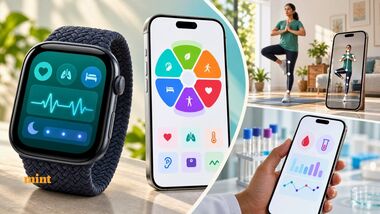
Apple has announced health upgrades covering heart monitoring, daily recovery and longer-term wellbeing. Its new Health Sensing System arrives on Apple Watch Series 12 and Ultra 4. A redesigned Health app will add personalised insights, movement checks and expanded cycle tracking.
New optical and electrical sensors support more frequent heart measurements. Larger, efficient green lights help measure heart rate every five seconds throughout the day.
says this also improves the accuracy of the Exercise and Move rings. Updated heart screens and watch-face shortcuts show current readings.
Apple claims leading accuracy following comparisons involving over 1,000 participants from different backgrounds. This is the company’s reported finding.
Heart rate variability (HRV) measures differences in timing between heartbeats. The watches measure it at best every 5 minutes, making readings 24 times more frequent.
Recovery HRV highlights daily stress and recovery signals. Overall, HRV offers broader health insights, including heart health. Higher variability generally suggests better recovery.
Overnight Vitals compares Recovery HRV with your usual readings. A daytime view could flag changes before bedtime.
Readiness combines recent activity, vital readings and sleep scores into a daily 0-10 score. It recommends Recover, Pace Yourself, Ready or Go For It.
The score updates throughout the day, reflecting workouts and changing readings. Users can check which factors influenced it. Apple developed the system using study data and input from doctors and exercise scientists.
The redesigned Health app brings features with iOS 27 and iPadOS 27. Its Insights tab updates summaries covering heart health, sleep, readiness, fitness, vitals and cycle tracking.
For You offers personalised suggestions and articles. These could include improving bedtime routines after several late nights.
The Longevity tab covers heart health, sleep, mental wellbeing, movement, metabolism, hearing and nutrition. Health Age compares your health measurements with your actual age.
It considers fitness, resting heart rate, sleep and HRV. Blood sugar and cholesterol test results can enrich the analysis.
Information can come from Apple devices, medical records and outside apps or devices. Visual summaries, evaluations and laboratory results help explain different health areas.
An iPhone camera and supported sensors enable checks of flexibility, strength, balance and movement. Tests also estimate aerobic fitness, called VO2 max.
Artificial intelligence (AI) gives immediate spoken and visual feedback. Processing happens on the device, without recording, storing or sharing video. Expert videos, articles and suitable exercise plans explain results and possible improvements.
Users can already import laboratory results and follow trends. New bookings will offer over 50 health markers for $119. Testing involves around 2,000 Quest Diagnostics locations across America.
Users can log menopause stages, symptoms and changing cycles. Logged bleeding after menopause triggers advice to contact a doctor.
Users aged 40 upwards may receive alerts about patterns suggesting perimenopause, the transition before menopause. Educational articles and expert tips provide further guidance.
Workout Buddy works without a nearby iPhone and supports more fitness data in English and Spanish. AirPods Pro 3 can share heart rate readings with compatible gym machines via iPhone. Improved treadmill calculations aim to measure distances more accurately from the first step.
watchOS 27 arrives on 14 September for Series 9 and SE 3 onwards and Ultra 2 onwards. It requires iPhone 11 onwards or SE 3, running iOS 27. The Apple Watch Series 12 starts at $399 in the US and ₹56,900 in India. The Apple Watch Ultra 4 starts at $799 in the US and ₹1,09,900 in India.
The Pro starts at ₹1,64,900 while the iPhone 18 Pro Max starts at ₹1,79,900 in India. The iPhone Duo, Apple’s first foldable smartphone, starts at ₹2,99,900 in India.
The redesigned app arrives later this year, initially in US English. It needs an Apple Intelligence-compatible iPhone or iPad; some features require an iPhone specifically.
Health Age needs an Apple Watch. VO2 max tests need supported heart sensors, including Watch or AirPods Pro 3.
Some features require adulthood, and regional availability varies. Apple says health information remains private, secure and controlled by users.