



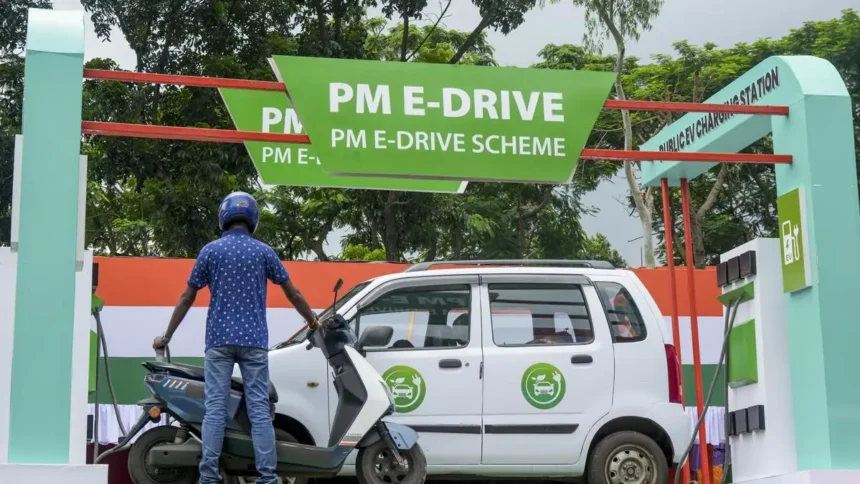
India’s electric vehicle (EV) ecosystem is rapidly broadening beyond its traditional urban hubs, with Uttar Pradesh, Karnataka and Telangana emerging as major centres of electricity consumption by public charging stations (PCS).
Latest data from the Central Electricity Authority show that power consumption by EV public charging stations across India rose to 1,558.69 million units (MU) in FY26, more than three times the 465.85 MU recorded in FY24. While Delhi and Maharashtra continue to account for a significant share, Uttar Pradesh, Karnataka and Telangana have rapidly increased their contribution.
UP is the biggest surprise entrant. Its share of pan-India electricity consumption by EV charging stations was below 1 per cent before FY24 but rose to 5.12 per cent in FY26.
Kazam CEO Akshay Shekhar said UP’s growth is likely being driven by a combination of e-rickshaw and electric three-wheeler penetration, NCR spillover, highway and inter-city charging, logistics movement and the formalisation of charging loads under DISCOM-connected PCS categories.
Power consumption by EV public charging stations across India rose to 1,558.69 million units in FY26
| Photo Credit: ALLEN EGENUSE J
Karnataka’s rise is strongly aligned with both existing charger density and fresh PM E-DRIVE momentum. It has India’s largest installed charging base. A similar story is playing out in Telangana. These States also have a more mature EV ecosystem with higher presence of EV start-ups, OEMs, fleet & charging operators and digitally enabled consumers, he noted.
Delhi’s declining share of national EV charging consumption does not indicate a contraction in the capital’s EV ecosystem; rather, it reflects the rapid broad-basing of EV adoption across the country. While Delhi’s own charging consumption has continued to rise — from 203.1 MU in FY24 to 453.3 MU in FY26 — other States have expanded faster. In effect, Delhi is not losing its EV lead so much as the rest of India is catching up.
The Kazam founder expects electricity consumption by public charging stations to continue rising sharply and potentially cross 2,500-3,000 MU in FY27, depending on the pace at which sanctioned chargers become operational and commercial fleets shift to electric vehicles.
The trend points to the next phase of India’s EV transition being increasingly about energy infrastructure, rather than merely vehicle sales. States that can combine rapid charger deployment with reliable electricity supply, smart load management, high charger uptime and interoperability are likely to capture a growing share of the country’s EV charging demand.
Published on August 18, 2026