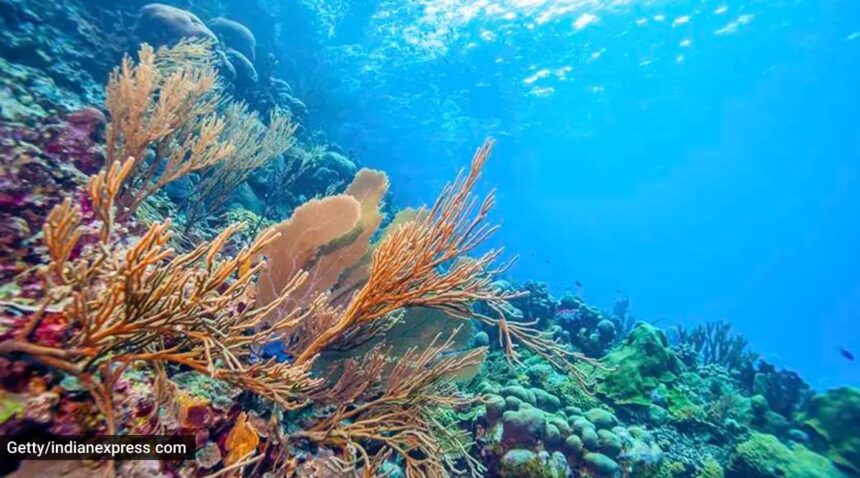
Coral colonies and giant clams that will be impacted due to the work on the transhipment port proposed at Galathea Bay as part of the Great Nicobar Island (GNI) mega project will be translocated to four sites on the west coast of the islands, the Zoological Survey of India (ZSI) has said.
ZSI informed this to the committee overseeing the implementation of biodiversity-related issues as part of the project’s environmental management plan for translocation during its fourth meeting, held on November 7, according to the minutes. The minutes of the meeting were made public by the Andaman and Nicobar Island Integrated Development Corporation Ltd (ANIIDCO) only on June 10.
The minutes stated that ZSI has identified “four new translocation sites on the west coast of Great Nicobar Islands and undertake the translocation of coral colonies and Giant Clams from the project impact area as per EC (Environmental Clearance) and CRZ (Coastal Regulation Zone) clearance conditions prior to the commencement of project works”.
The minutes added that it will maintain systematic data on “translocated colonies with GPS tags to each colony to monitor its survival.”
The biodiversity-related committee has been formed in compliance with the specific conditions laid down by the Environment Ministry while granting EC to the project, to implement an environmental management plan. This committee is tasked with overseeing wildlife conservation plans and actions to mitigate the project’s impact on the endemic Nicobar Megapode, leatherback marine turtles, saltwater crocodiles, Nicobar Macaque, Robber Crab, coral translocation, and other birds found only on the island.
Galathea Bay is one of the most crucial nesting sites globally for the leatherback sea turtle.
Two other committees, on pollution-related measures and to oversee welfare issues related to Shompen and Nicobarese tribal communities, have also been formed.
At the time of the project’s appraisal for EC, as well as during the challenge against the project before the National Green Tribunal, ZSI, which comes under the Ministry of Environment, Forest and Climate Change, had submitted that it would translocate 16,150 coral colonies from the peninsular part of Galathea Bay. There are 20,668 coral colonies in a 10-hectare area, and the remaining 4,518 are to be observed before a decision is taken on their translocation.
While the Centre has maintained that no corals are found on the eastern flank of Galathea Bay, which is the site of the transhipment port, this claim was contested before the National Green Tribunal in a challenge against the project’s alleged environmental violations by environmental activist Ashish Kothari.
The government’s own maps and reports on the Island Coastal Regulation Zone (ICRZ) Plan were relied upon to show the presence of corals in the project area, and argue that their translocation is not a permissible activity under law.
However, the National Green Tribunal, in its February 16 order this year, ruled that the ICRZ Notification, 2019, was not violated and directed the Centre to protect coral reefs along the coastal stretch, in compliance with the specific conditions laid down in the project’s EC. It also directed ‘coral regeneration’ in appropriately identified areas abutting project areas.
ZSI also said in the November 7 meeting it will obtain approvals under the Wildlife Protection Act, 1972, before handling Schedule-I species, such as coral colonies and giant clams, which are accorded the highest protection. It also stated that manpower has been engaged and that survey equipment has been procured for the conservation and management of coral reefs and for intertidal marine fauna proposals.
Meanwhile, the Wildlife Institute of India, which has been entrusted with the conservation of Nicobar Megapode and Leatherback Turtles, said during the meeting that a survey had found 141 leatherback turtle nests. It did not specify the survey period.
The committee’s biodiversity expert, Deepak Apte, suggested that satellite tagging of turtles should be prioritised to track their movements before the commencement of project work.
The Salim Ali Centre for Ornithology and Natural History informed the monitoring committee that a pilot survey of endemic and tree-cavity-nesting birds has been completed in GNI, while another on Coconut Crabs is currently in progress.