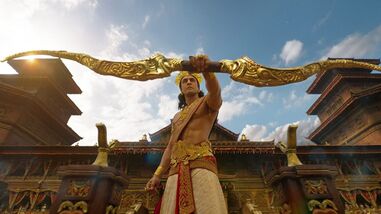
For generations, the Ramayana was a Sunday morning television ritual. But today, November 5, the epic has reached new heights as Bollywood star Ranbir Kapoor steps into the role of Lord Ram, carrying that formidable legacy with a cinematic adaptation of unprecedented scope.
Directed by and featuring Sai Pallavi as Goddess Sita and Yash as Ravana, the film is backed by a staggering ₹4,000-crore investment covering two instalments and a massive global rollout.
Tiwari, however, faces a unique challenge: recreating a beloved epic for an audience that already holds deeply entrenched memories of how its deities should look, speak, and behave.
While expensive visual effects can build and Lanka, winning over the cultural consciousness requires considerably more.
Producer Namit Malhotra’s earliest entrepreneurial gamble was small enough to fit into a garage, though the consequences of failure were hardly small for his family.
He has recalled starting a computer-based editing business with about ₹7 lakh, funded partly by his father and partly through a bank loan. As the operation grew, the family mortgaged its home to help finance it. At one point, the business had a turnover of ₹75 lakh against a mounting loan of ₹2 crore.
“We would have become homeless,” he recalled, according to reports.
Decades later, Malhotra heads the visual-effects powerhouse DNEG and backs Ramayana through Prime Focus Studios. The scale of his current wager is astronomical.
The reported ₹4,000 crore figure for the project covers both the cinematic instalments and their global promotional campaigns, though the individual budget for Part One has not been officially announced.
Kannada superstar Yash, whose Monster Mind Creations is a production partner, has also spoken about the heavy capital expense required to take the films to an international audience—meaning the actor playing Ravana also holds a major producer’s stake in how the film performs.
The star-studded ensemble extends well beyond the core trio. plays Lakshman, Sunny Deol plays Hanuman, and Rakul Preet Singh appears as Surpanakha.
Industry veterans Arun Govil, Lara Dutta, and Faisal Malik also feature, while musical legends AR Rahman and Hans Zimmer have collaborated on the film’s sprawling score.
Beyond the extensive visual effects, some of Ramayana’s most absorbing production details involve physical objects meticulously crafted for the cast.
According to NDTV Profit, jewellery house Tribe Amrapali spent 18 months creating more than 4,000 pieces for the film. These ornaments were designed specifically for distinct character arcs and moments—palace jewels had to visually give way when the narrative moved into exile, while Ravana’s imposing appearance demanded an entirely different design philosophy.
“You’re not doing one film, you’re doing 10,” Tarang Arora told The Hollywood Reporter India.
The attention to detail was rigorous; an ornament could be rejected simply because its motif mirrored a design on a background curtain. The pieces also had to register clearly on a giant screen while allowing the actors wearing them the mobility to perform.
To achieve this aesthetic, much of the golden appearance was achieved using materials such as plated brass.
Arora told NDTV that Raja Ravi Varma’s paintings, ancient architecture, and archaeological references helped shape the designs, alongside his own childhood memories of watching the classic television broadcast. He described the new film as the definitive version his children’s generation would grow up with.
The epic’s theatrical version boasts a runtime of 195 minutes (three hours and 15 minutes). With an intermission, it is positioned as a major festive outing for families, aided by a U certificate that allows unrestricted public exhibition.
However, overseas viewers may encounter a distinctly different edit. Malhotra has said the team prepared separate Hindi and English masters, with the English version including script changes and a separate cut tailored for global sensibilities.
Ramayana has received glowing early reviews. The Guardian’s Peter Bradshaw praised its spectacle and storytelling energy.
According to industry tracker Sacnilk, Ramayana has already earned ₹ ₹22.60 crore net in early ticket sales on its opening day. This figure represents only the early shows across India as of 1:00 PM on Thursday.
At 8 pm on November 4, Sacnilk put advance bookings across all available dates at ₹111.89 crore, including blocked seats, and ₹90 crore without them.
Sony Pictures’ overseas rollout has been billed as enormous, with reports outlining plans for more than 50,000 international screens alongside roughly 9,000 in India.
Fans will have to wait longer for Ramayana Part Two, as the makers have moved it from its earlier 2027 slot to 2028. Malhotra says the team needs the additional time for the finale.