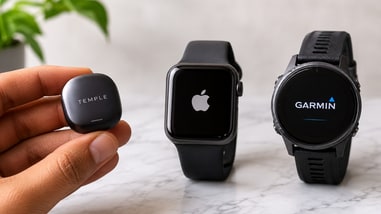
Deepinder Goyal’s new wearable, Temple, is entering a market already dominated by products from Apple, Garmin, Fitbit and other fitness technology brands. But unlike a worn on the wrist, Temple is attached to the side of the forehead, near the temple. Its price is also likely to prompt potential buyers to take a closer look: the device is available for pre-order in India at ₹85,000.
The wearable is being developed by Goyal’s health-tech venture and is designed to track physiological signals. The company says it can measure changes in blood circulation in the brain and provide information about how the body responds to physical activity, , and recovery.
Pre-orders opened in India on 1 November. Deliveries are expected to take around three months, while the first batch is being produced on a made-to-order basis. The package includes lifetime access to the software platform, adhesive patches called Grips, a charging pod and personal onboarding.
The key question, however, is what buyers get for ₹85,000 and whether Temple offers enough over established fitness trackers to justify its price.
Temple’s main difference is its location and the type of information it aims to collect. It uses optical sensors placed against the skin near the superficial temporal artery. The company has developed two main measurements: BrainFlow and .
BrainFlow is designed to track relative changes in blood circulation associated with the brain. Entropy is a score ranging from 1 to 250, intended to show how hard the body is working to maintain itself. According to Goyal, the score can change with sleep, exercise, stress, food, caffeine and meditation.
Apple Watch and devices, meanwhile, focus on a wider set of everyday fitness and health features. They track heart rate, workouts, sleep and activity, while supported models also offer features such as blood oxygen measurements, ECG readings and heart-rate alerts.
Garmin’s sports watches are particularly known for GPS tracking, training information, recovery estimates and performance data for runners and endurance athletes.
Temple is not designed to replace these functions. It does not offer the same smartwatch experience, with features such as notifications, calls, apps or built-in navigation. Its pitch is more specialised: it wants to provide additional information about physiological strain and signals from the head.
There is also a price difference between the three products. Apple’s starts at ₹56,900, while Garmin’s Forerunner 970 is listed at ₹92,990 on Garmin India’s website. Temple’s ₹85,000 price puts it above the Apple Watch Series 12 but below Garmin’s high-end running watch.
The difference is in what each device is built to do. Apple offers a mix of health tracking and smartwatch features, while Garmin focuses strongly on sports performance, GPS, training readiness and . Temple is trying to create a separate category around measurements linked to brain circulation and overall physiological strain.
Goyal has also claimed that Temple can measure heart rate more accurately than leading wearables, including Apple Watch and Garmin. In a study shared by the company, Temple was compared with the Apple Watch Series 12, Garmin Forerunner 970, Fitbit Air, WHOOP MG and Oura Ring 5.
The company used a Polar H10 chest strap as its reference device and tested the wearables from rest to high-intensity exercise. According to the results shared by Goyal, Temple recorded lower measurement errors across the exercise zones, with the Apple Watch coming closest.
He also claimed that Temple performed better than a conventionally worn chest strap during the most intense exercise zones.
However, these are findings from a company-led study. Independent testing is still needed before the results can be treated as established evidence. Goyal has said that the research paper and data are available and that the company is open to independent researchers testing the device.
The scientific debate around BrainFlow is a separate concern. Doctors have questioned whether an optical sensor placed near the temple can reliably measure changes in blood circulation inside the .
The superficial temporal artery supplies blood to the scalp and face, while the brain receives blood mainly through other arteries. Critics argue that changes in scalp circulation do not necessarily show what is happening inside the brain.
Two company-funded research papers have reported findings related to BrainFlow, but they have not yet been reviewed by other independent researchers, according to The Economic Times. Goyal has defended the device, saying it is a fitness and wellness product, not a medical device. He has also said it is not proven to diagnose or prevent any disease.
For someone looking for a conventional fitness tracker, an Apple Watch or Garmin device offers a more familiar set of features. They provide established tools for tracking workouts, sleep, and daily activity, along with functions that have been tested by a much larger user base.
Temple is aimed at people interested in its additional physiological measurements. Its price includes lifetime access to the software, but buyers are being asked to pay a premium for a product whose central claims still need wider independent validation.
The device could offer a new way to track the body’s response to exercise and stress. But its long-term value will depend on whether independent research supports the measurements it promises and whether users find the information useful in everyday life.
For now, Temple is an ambitious entrant in the wearable market, but it is not a direct replacement for an Apple Watch or Garmin. Its biggest test will be proving that its new measurements offer something meaningful beyond the health and fitness data already available on established devices.