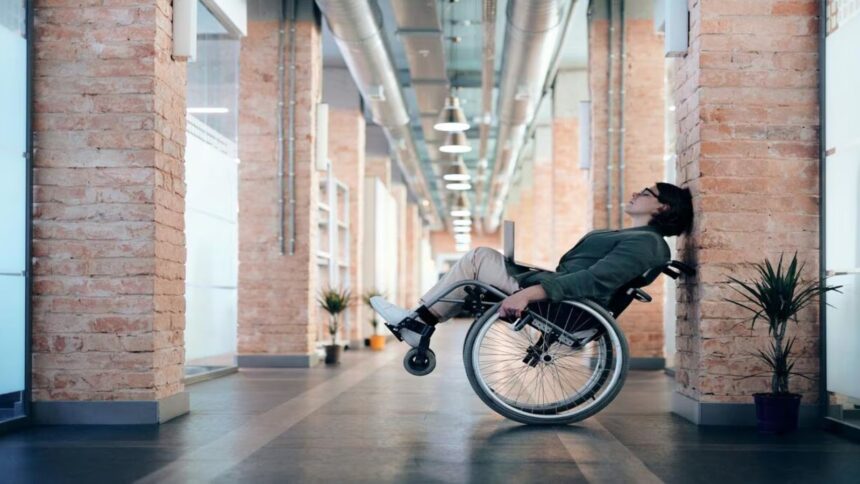
Sasha Blair-Goldensohn is on a tech-driven mission to help people with disabilities travel easier. Blair-Goldensohn, a software engineer at Google, was paralyzed from the chest down in 2009, when a 100-pound tree limb fell on him in Central Park. Since then, his perspective as a wheelchair user has inspired him to build out Google Maps accessibility features and to push for all-around inclusivity.
“There’s a huge swath of the population that isn’t visible — not because we don’t want to be out there in the community, but because out of sight, out of mind,” said Blair-Goldensohn, who is now the disability inclusion feature lead at Google.
According to the World Health Organization, an estimated 1.3 billion people — or 16% of the world’s population — experience significant disability. That’s more than 70 million adults in the United States.
Many of them rely on Google Maps features that show stair-free entrances and provide audio guidance to navigate streets and find places such as restaurants, ATMs and accessible transit stations. Blair-Goldensohn has helped oversee the introduction of wheelchair-accessible transit routes and, more recently, stair-free surface routes.
Google Maps isn’t the only mapping app for navigating accessibility when you get to an unfamiliar city. AVIV ScoutRoute customizes routes for people with limited mobility or vision, relying on user feedback and AI to account for factors like sidewalk width, steepness, surface composition, curb ramps and landmarks.
Here are three other tools that can ease the way for travelers with disabilities.
RollMobility
After Rachel Zoeller became a wheelchair user in 2019 as a result of a spinal cord injury, going out to meet friends took strategy and research. She would call a restaurant to ask about accessibility, get verification, then arrive to find out, say, that the door wasn’t wide enough or the tables were too close together — or there was carpeting, which can take more shoulder strength to wheel across. She joined a team creating RollMobility, a free app, to address those critical details.
“When you’re home, you have your go-to places. You know what to do to navigate the space when you get there,” Zoeller said. “When you go somewhere new, it can feel like a guessing game to someone in a wheelchair whether they’ll be able to get around a bar or hotel.”
The Americans With Disabilities Act Standards for Accessible Design establish basic requirements for accessibility, like entrance access and the path of travel to restrooms, but they still leave gaps. Many businesses were grandfathered in and were never forced to retrofit their spaces.
The RollMobility app aims to help users navigate those types of spaces by offering crowdsourced details such as table and bar heights and door weight — heavier doors can be harder to open with limited mobility. Since the service began in 2023, more than 20,000 places in over 100 countries have been evaluated.
“Tools like ours,” Zoeller said, “try to bridge the gap between a fully actualized ADA and today’s reality.”
In the meantime, users say the app makes navigating easier.
“The app allows me to plan,” said Chris Layne, a wheelchair user and former Ms. Wheelchair Colorado. “If I’m meeting friends, I can know ahead of time how accessible the bathroom at a restaurant is and whether I and my mother, who uses a walker, can use it.”
Be My Eyes
Eleven years since Hans Wiberg, who is blind, created Be My Eyes, the app has registered more than 10 million volunteers to help guide people who are blind or have limited sight through everyday life. Collectively, that crew speaks 185 different languages. The site has nearly 1 million blind or low-vision users.
Here’s how it works: Users who need help log on to the app any time of day, anywhere in the world, and they’re connected with a volunteer who speaks their language. They then point a smartphone camera at their surroundings and the volunteer provides a real-time description of what’s happening and can engage in conversation. There’s also an AI feature that allows the user to share a photograph, and a chatbot will describe what it sees.
That means if you’re traveling, you can get immediate, personalized assistance navigating unfamiliar streets or getting the lay of the land in a hotel room or restaurant. It’s especially useful to have guidance in your own language when traveling abroad.
Wheel the World
Standard travel agencies often overlook disabled travelers’ specific needs, but services including Wheel the World, a web-based travel agency, offer traditional booking services as well as travel packages that can include accessible transportation, tour guides and specialty equipment such as amphibious wheelchairs and adaptive kayaks.
More than 800 freelance “mappers” have gathered about 225 data points per hotel for more than 6,000 properties in 50-plus countries, with the majority in the United States, creating a vast database of important details such as bed heights, door widths, bathroom accessibility and dimensions. Users can match their needs with a hotel’s features.
Wheel the World marks a property with a “verified” badge based on standards that were created through interviews with more than 100 members of the disability community. If a user books a hotel that doesn’t precisely match the online details, Wheel the World provides a refund.
“Accessibility is not one size fits all,” said Arturo Gaona, a co-founder of the service.
This article originally appeared in The New York Times.