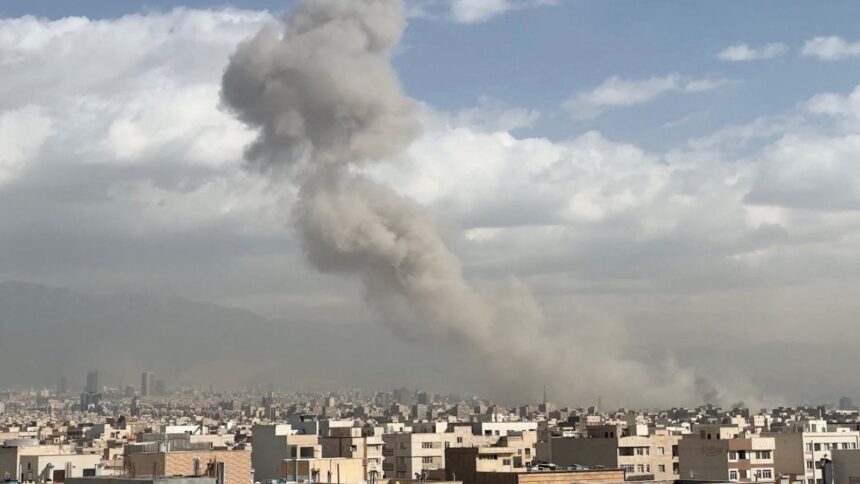
In response to the ongoing strikes carried out against it by Israel and the US, Iran launched waves of drones and missiles targeting Israeli territory and US-linked assets in the Gulf.
Iran started developing its missile programme during the Iran-Iraq War of the 1980s and its stockpile has since grown in scale and diversity. Here’s a look at Iran’s diverse and massive drone, ballistic and cruise missile arsenal.
Ballistic Missile Arsenal
Ballistic missiles work by taking a parabolic path through the atmosphere, and travel faster than drones and cruise missiles. They are usually harder to intercept. Iran possesses a substantial range of Short-Range Ballistic Missiles (SRBMs), Medium-Range Ballistic Missiles (MRBMs) and potentially Intermediate-Range Ballistic Missiles (IRBMs). Most of these have the capability to hit other West Asian countries, while European countries such as Britain, France and Germany fall within the range of Iran’s medium-range missiles. The US, however, remains out of range.
According to reports, Iran has yet to possess an Intercontinental Ballistic Missile (ICBM) which can target countries as far as the US, even though it has successfully developed the Ghaem-100, a three-stage, solid-fuelled satellite launch vehicle (SLV).
Iran’s long-range missiles are capable of striking targets of up to 2,000 km, covering most Middle Eastern countries and parts of Europe.
According to open-source studies, Iran’s long-range missiles, with a range of 2,000 km, include Sejil, Ghadr, Khorramshahr and Kheibar.
Iran’s arsenal has a variety of medium-range missiles including Shahab-3, with a range of 1,300 km, Emad (1,700 km), Hoveyzeh (1,350 km), Haj Qasem (1,400 km), Fattah-1 and Fattah-2 solid-fuel hypersonic ballistic missiles with a strike range of upto 1,500 km.
Iran also possesses SRBMs such as Shahab 1 and Shahab 2, with a range of 300 km and 500 km respectively; the Qiam 1 with a range of 700-800 km, Fateh-110 (300 km) and Zolfaghar (700 km).
Tehran had also reportedly acquired the Soviet-era Kh-55 long-range air-launched cruise missiles from Ukraine, with a range of up to 3,000 km; the Soumar ground-launched cruise missile with an estimated range of up to 3,000 km; the Ya Ali land-attack cruise missile (LACM) with an operational range of about 700 km and the Ra’ad anti-ship cruise missile with a reported range of 300-350 km.
In June 2023, Iran had unveiled its first indigenous hypersonic ballistic missile.
Iran possesses a variety of military UAVs in its arsenal for various missions—including surveillance, reconnaissance and precision strikes.
The UAVs in its arsenal include Ababil 3, Mohajer 6, Shahed 129, Shahed 136, Shahed 199 and Kaman 22 – which range from 200 km to 3,000 km.
Of these, Shahed 136, Hadid-110 and Arash can be used for suicide and Kamikaze-style strikes.
Following the attacks by Israel and the US, Tehran carried out drone strikes on US Navy facilities in Bahrain and Kuwait and also at civilian centres in Dubai, UAE and Doha. Some of the attacks also involved missiles.