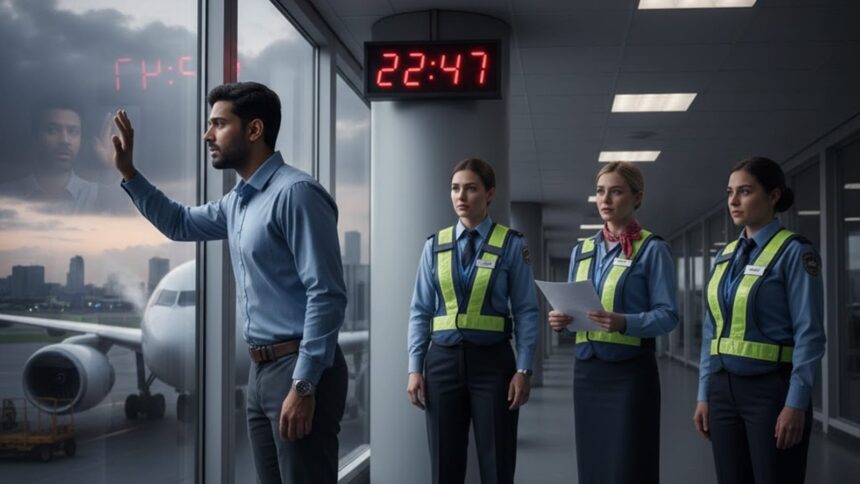
Did you know that after check-in and security at the airport, if you refuse to board the flight due to an emergency after entering the aerobridge, you will be held until the aircraft departs (and even lands) for security reasons. But why? To better understand, we reached out to K Anuradha Suresh, an aviation expert and a Retired Senior AGM from Air India, who explained that we must separate airline procedures from airport security logic.
“Once a passenger clears security, crosses the boarding gate, and enters the aerobridge, they are inside a sterile airside zone connected directly to the aircraft. At that stage, movement is tightly controlled. It is no longer a public terminal space,” said Anuradha.
From a security standpoint, once a enters the aerobridge or aircraft-proximate area, authorities must consider the possibility, however remote, that an item may have been left behind or that aircraft-linked equipment may have been accessed. “So, the foolproof method to avoid any threat of violence is to abstain from the passenger in the controlled area itself,” said Anuradha.
According to the expert, aviation security protocols are designed to “eliminate even low-probability risks”. “It is not about suspicion of intent, but about maintaining the integrity of a controlled zone. Any uncontrolled exit creates a verification requirement, and containment becomes the simplest compliant response,” said Anuradha.
Operationally, the aerobridge is a monitored, access-controlled corridor. “Keeping the passenger there avoids reopening the sterile boundary, triggering re-screening procedures, or deploying additional security resources. That said, while the security logic may be justified, passenger handling can always be more sensitive. Safety must take precedence…but experience need not be disregarded,” said Anuradha, adding that in aviation, “balance defines operational maturity”.
When a passenger wants to deboard after reaching the aerobridge (especially in India), three authorities are involved, each with a clearly defined role. This includes CISF (Central Industrial Security Force, responsible for terminal security screening, sterile zone integrity, access control between landside and airside, and ensuring no breach of restricted areas); Airline authority, and Airport authority (which manages aerobridge infrastructure, gate control, CCTV, and physical access coordination. They facilitate logistics but do not decide security policy.)
Even in emergencies, de-boarding procedures involve not only the airline but also airport security. “This is a bit of a hassle for everybody. Additional coordination between and airport authorities, formal documentation, security manpower allocation, etc.,” contended Anuradha.
It’s collaborative, said Anuradha.
But in practical terms:
If the issue is sterile zone integrity…CISF leads.
If the issue is baggage or flight legality… Airline leads.
If the issue is physical holding area …Airport operator supports.
“In domestic short-haul cases, if no baggage is checked and the aircraft is about to depart, CISF may prefer containment (e.g., keep the passenger in the aerobridge) rather than reopening the sterile boundary,” described Anuradha.
This held up “may end with aircraft takeoff too” in some cases, said Anuradha.
How about long-haul flights?
For domestic flights, the maximum time one can be held in the controlled area is 3 hours, which may be justified. “But if it’s long haul flight, one can’t be kept there for hours together. For international flights, the process is even stricter due to immigration, security, and baggage protocols, which means the cumbersome deboarding procedure has to be followed to release a genuine passenger,” said Anuradha.
Process usually becomes:
The airline crew informs the captain.
CISF authorises escorted movement.
Passenger taken to a controlled holding area.
Immigration reversal processed (if already stamped).
Baggage identified and removed.
Manifest and load sheet updated.
“This is structured. Documented. Logged. No one sits on an aerobridge for 12 hours,” said Anuradha.