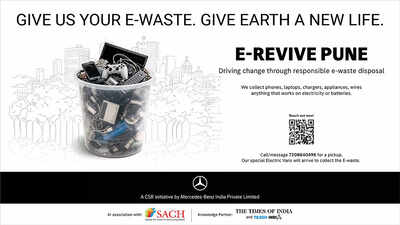
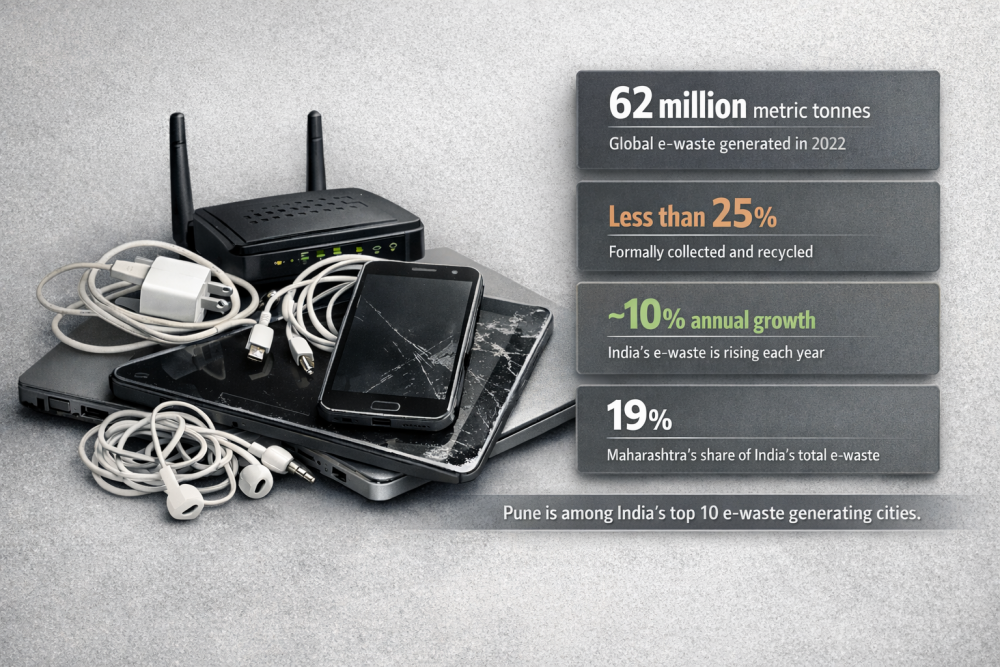
Picture this: somewhere in your home right now, there is a drawer holding the ghost of your digital past : a phone from three upgrades ago, a pair of earphones with a broken jack, a laptop replaced when the office switched systems, perhaps a router, a tablet or a smartwatch with a cracked screen that never quite warranted a repair. You have not thrown them away, but you have not done anything with them either; they simply… rest. We are a generation that has embraced technology with remarkable ease with upgrading, adapting and staying current, yet the question of what happens at the end of a device’s life has largely gone unanswered. That quiet accumulation inside our homes reflects a much larger challenge the world is only beginning to confront.Electronic waste is among the fastest-growing waste streams worldwide. According to the Global E-waste Monitor 2024 published by the United Nations1, approximately 62 million metric tonnes of e-waste were generated globally in 2022, and this volume is increasing by about 2.6 million tonnes annually, with projections indicating it will reach 82 million tonnes by 2030, a 33% rise. India reflects this global trend at a significant scale, with estimates from the Ministry of Electronics and Information Technology (MeitY)2 suggesting that e-waste generation will reach around 2 million metric tonnes by 2025, up from nearly 0.7 million metric tonnes in 2015; this trajectory is further reinforced by current estimates that e-waste in India is growing at an annual rate of about 10%, driven by increasing access to electronic devices and shorter product life cycles.Within India, Maharashtra plays a significant role in the country’s e-waste landscape. The state accounts3 for nearly 19% of India’s total e-waste generation, about 3.96 lakh tonnes annually, the highest among all states. Yet the gap between generation and formal recycling remains substantial, underscoring the need for stronger collection and processing systems.Cities are where this challenge becomes most visible, and Pune is no exception. The city4 is among India’s top ten e-waste generating cities, accounting for about 5.6% of the country’s total urban e-waste, according to city-wise estimates. It ranks after larger metropolitan centres such as Mumbai, Delhi, Bengaluru, Chennai, Kolkata, Ahmedabad and Hyderabad, reflecting the scale at which technology consumption has become embedded in the city’s everyday life. From the lecture halls of Deccan to the offices of Magarpatta, from Laxmi Road’s electronics lanes to the housing societies of Baner and Balewadi, technology has become part of everyday life in Pune. But every device that enters a home must eventually leave it and when it does, it becomes part of a challenge cities are only beginning to manage responsibly.These are not abstract numbers. They represent millions of devices each containing materials that, when handled responsibly, can be recovered and reused, but when discarded carelessly, can pose serious risks to the environment and to public health. E-waste is not simply waste. It is a resource that has, for far too long, been treated as one. Every device we discard can become either an asset in the making or a hazard in waiting; the outcome depends entirely on how it is handled at the end of its life.There is also a dimension of this conversation that rarely gets discussed in everyday settings: data security. Old phones and laptops carry far more than memories like personal information, financial data, work correspondence etc. Devices that are carelessly discarded without proper data erasure can become sources of risk that their owners never anticipated. Responsible e-waste disposal is, in this sense, not just an environmental act. It is a personal one.The considered choice is always ours to makeMaharashtra5 has long led the country in formal e-waste processing, demonstrating how the right mix of policy intent and recycling infrastructure can create meaningful progress. The state hosts several authorised recycling facilities and ranks among the leaders in registered dismantlers and recyclers listed by the Central Pollution Control Board under India’s E-Waste Management Rules 20246, creating a structured pathway for the safe collection and processing of discarded electronics. Building on this foundation, the state’s urban centres are now well positioned to strengthen responsible e-waste disposal systems further, with cities such as Mumbai and Pune already supported by authorised recycling channels alongside growing municipal and private initiatives that promote organised collection and responsible disposal. It was this conviction that gave rise to E-Revive Pune, a CSR-led initiative by Mercedes-Benz India Private Limited, implemented in partnership with the Society for Action in Community Health (SACH), built on a simple but powerful premise: responsible e-waste disposal should not be an effort. It should simply be a habit.
The initiative brings the solution directly into the spaces people already inhabit, certified e-waste collection points established across residential complexes, school and college campuses, corporate offices, and local marketplaces. A student depositing an old tablet before class. A family offloading broken appliances during a society collection drive. A professional leaving behind a retired work device on the way out of the office. Each act is small. Together, they represent something far larger: a city collectively choosing to close the loop on its own digital consumption.E-Revive Pune aims to engage institutions and communities across the city by creating a structured pathway for responsible e-waste disposal. Through certified e-waste collection points planned across residential complexes, school and college campuses, corporate offices, and local marketplaces, the initiative will make it easier for citizens to dispose of electronic devices safely and responsibly. Every device deposited through these channels will enter certified recycling streams, where it will be handled safely, traceably, and in full compliance with India’s E-Waste Management Rules. The goal is not just collection but accountability, end to end, from the moment a device is deposited to the moment it is responsibly processed.What makes this initiative resonate beyond its logistics is what it asks of people: not sacrifice, not inconvenience, but simply awareness and a single, considered action. Responsible e-waste disposal begins with awareness, and awareness, once sparked, has a way of spreading far beyond the person it first reaches.Through E-Revive Pune, Mercedes-Benz India is empowering citizens to dispose of electronic waste safely, reduce environmental hazards, and contribute to a cleaner, greener city. Participate in a collection drive. Do your part for the environment and dispose of . The infrastructure is in place, the movement is growing, and that drawer, the one quietly filling up at the back of your cupboard, is not a burden. It is the beginning of something worth being part of.Sources * Press Information Bureau. (n.d.). Press release. Government of India. https://www.pib.gov.in/PressReleseDetailm.aspx?PRID=2155124®=3&lang=2
- Baldé, C. P., Kuehr, R., Yamamoto, T., McDonald, R., D’Angelo, E., Althaf, S., Bel, G., Deubzer, O., Fernandez-Cubillo, E., Forti, V., Gray, V., Herat, S., Honda, S., Iattoni, G., Khetriwal, D. S., Luda di Cortemiglia, V., Lobuntsova, Y., Nnorom, I., Pralat, N., & Wagner, M. (2024). The global e-waste monitor 2024. United Nations Institute for Training and Research (UNITAR) & International Telecommunication Union (ITU). https://ewastemonitor.info/the-global-e-waste-monitor-2024/
- Ministry of Electronics and Information Technology. (n.d.). Electronic waste and India. Government of India. https://www.meity.gov.in/static/uploads/2024/02/7ab.pdf
- Kumare, S. (2023). E-waste management in Nagpur district. International Journal of Novel Research and Development, 8(1), c701–c710. https://www.ijnrd.org/papers/IJNRD2301291.pdf
- Ministry of Electronics and Information Technology. (2024). Electronic waste and India (p. 4). Government of India. https://www.meity.gov.in/static/uploads/2024/02/7ab.pdf
- Government of Maharashtra, Economic Advisory Council. (2023). Maharashtra Economic Advisory Council final report. https://mahasdb.maharashtra.gov.in/files/DSP/home/Maharashtra EAC Final Report.pdf
- Ministry of Environment, Forest and Climate Change. (2024). E-waste (management) third amendment rules, 2024 (G.S.R. 164(E)). Government of India, Central Pollution Control Board. https://cpcb.nic.in/uploads/Projects/E-Waste/E-waste-Third-Amendment-Rules-2024.pdf
- International Telecommunication Union, & United Nations Institute for Training and Research. (2024). The global e-waste monitor 2024. https://ewastemonitor.info/the-global-e-waste-monitor-2024/
Disclaimer: This article has been produced for education and awareness purposes only, on behalf of the Times Internet’s Spotlight team.
.