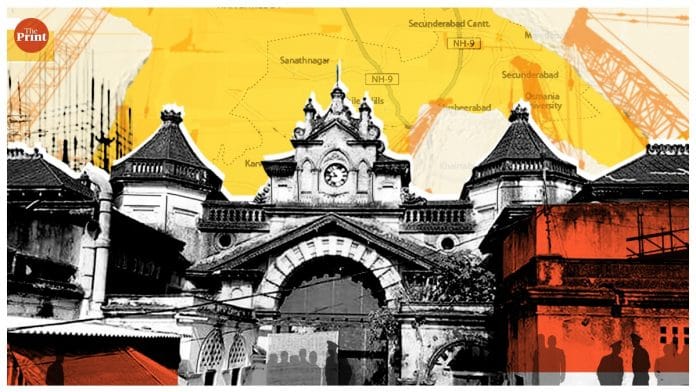
Osman Ali Khan, the seventh and last Nizam, died in 1967 leaving behind immense wealth and several properties. Among the most well-known are the Chowmahalla and Falaknuma palaces, the latter now a five-star hotel run by the Taj Group.
In 2023, soon after Mukarram Jah’s death, his son Azmet Jah was crowned the “ninth” Nizam by his immediate family, a move opposed by extended members. Azmet becoming the head of the family carries little social or political significance today; it is largely symbolic and linked to the family estates that Mukarram Jah inherited in 1967.
Even before Azmet assumed this position, Najaf Ali Khan, a grandson of Osman Ali Khan, had filed a case against Mukarram Jah’s family seeking an equal share or distribution of the properties among Osman Ali Khan’s descendants. According to Najaf, this is the case in which the Sahebzadagan Society attempted to implead itself three years ago.
“My case has been going on for five years. They have no right to claim any of the properties,” he told me.
The properties in question include Falaknuma Palace, Chowmahalla Palace, King Kothi Palace, Purani Haveli, and the Harewood and Cedars Palace in Tamil Nadu. The judgement in the matter, dated 22 January (though it surfaced only recently), settles one issue: the dispute over the properties will now be restricted to the descendants of the last Nizam, Osman Ali Khan, unless others can somehow prove they have a legal stake.
R Danie Ruth, XI Additional Chief Judge of the City Civil Court in Hyderabad, stated in the judgement that there was no material on record to show that all the individuals the society claimed to represent had authorised it.
The court further noted that the properties in question were private assets belonging personally to Osman Ali Khan. This effectively narrows the dispute to members of his direct line of descendants.
There is another legal dispute underway. Azmet’s half-brother, Azam Jah, has filed a civil case against Azmet and his mother, Esra, seeking what he calls his “rightful” share of the estates, claiming he was denied it.
As a Hyderabadi, this whole situation feels like a sad little mess. Sometimes I wonder how different the city might have been had these disputes not dragged on for decades. How difficult would it have been to put in place clear legal provisions about who inherits what?
We are fortunate that the Chowmahalla Palace has been restored and opened to the public. It remained shut for a long time until Esra returned to Mukarram Jah’s life and took charge of managing the family estates. While public monuments such as the High Court and Osmania Hospital will never face such issues, because they were built for the city, private palaces and historic buildings are also part of Hyderabad’s heritage and deserve preservation.
When legal disputes drag on for years, properties often remain closed, with no public access and little maintenance.
One example is the beautiful Hillfort Palace in Hyderabad. Built around 1915 by Nizamat Jung and later purchased by the last Nizam, the property was taken over by the state government after Hyderabad’s annexation by the Indian Army in 1948.
The building was eventually leased to a hotel but now lies in a dilapidated condition, out of sight and out of use. It could easily have been repurposed as something meaningful, like an art gallery, a museum, or another cultural space. The lack of foresight can be baffling at times.
Of course, private property is a different matter. With the Sahebzadagan Society now excluded from the ongoing suit between the last Nizam’s direct descendants, the dispute has at least narrowed.
That said, such legal battles do little to enhance the legacy of Mukarram Jah’s family.
Mukarram Jah himself was often remembered for how his grandfather’s wealth dissipated over the decades. While people may be fascinated by family drama, it might be wiser for the family to engage in serious conversations with those seeking a share and resolve the matter amicably.
(Edited by Prashant Dixit)