Last evening in Mumbai, inside the hushed, hallowed hall of the Jamshed Bhabha Theatre, a curious and quietly courageous thing occurred. A newspaper — that daily dispenser of declarations — invited its readers not merely to believe it, but to think with it. Not simply to consume truth, but to chase it.
Tesseract: The Geometry of Truth arrived with the promise of spectacle, and spectacle it delivered — dancers dazzling, music mounting, light leaping across the stage like lightning in a philosophical storm. But what lingered long after the applause subsided was not simply the splendour. It was the suggestion beneath the shimmer:
Truth is not a trophy handed down.
Truth is a task taken up.
I went to the theatre with Joyce Arora, who for years worked in the marketing and sales team of the — someone who understands the ecosystem of newspapers from the inside, the delicate dance between editorial ambition and the practical machinery that keeps a newsroom alive. Joyce is also the mother of two women who have become forces of nature in their own right — Malaika Arora and Amrita Arora. Yet the Joyce I know is not one drawn to flashbulbs and fanfare. She, like me, prefers the anonymity of the audience — the quiet privilege of sitting unseen while ideas take the stage.
The truth is we went for a friend.
Our scribe friend from the Times of India, Vinay Mishra, had invited us. And insisted. And reminded. The sort of gentle persistence only journalists possess — the belief that a story matters enough to pursue. Joyce and I finally said yes because we trusted him.
How lucky we are that we did.
Because what Vinay brought us to witness was not merely a performance. It was a provocation.
The evening opened with grace. Meera Jain stepped onto the stage to welcome the audience, her voice calm, composed, quietly compelling. Beside her stood Samir Jain, not rushing to speak but choosing instead to stand beside the voice that carried the room. In a world where power so often clamours for centre stage, the moment felt quietly radical.
Meera spoke of travel and theatre, of Broadway evenings and family journeys, of curiosity kindled across continents. It became clear that the inspiration for this ambitious production was born from experiences shared by the Jain family — the simple joy of watching stories unfold on stages across the world and the desire to bring that wonder home.
And here is where the conversation becomes interesting.
We live in an age addicted to accusation. Labels leap from lips faster than understanding. Someone is dismissed as elitist, someone else derided as entitled, another declared woke, another condemned as fascist. We fling these words like stones and call it discourse.
But sitting in that theatre, listening to Meera Jain speak, something else came into focus.
Yes, travel is privilege. Yes, exposure to global theatre is advantage. But what matters — what always matters — is what one chooses to do with privilege.
The Jain family could have kept those experiences to themselves. They could have continued travelling, watching theatre abroad, enjoying it privately, quietly, comfortably.
Instead, they chose to build something here.
They chose to bring that inspiration back to and share it with thousands of strangers.
That decision transforms privilege into something rarer.
It becomes a gift.
And what a gift it was.
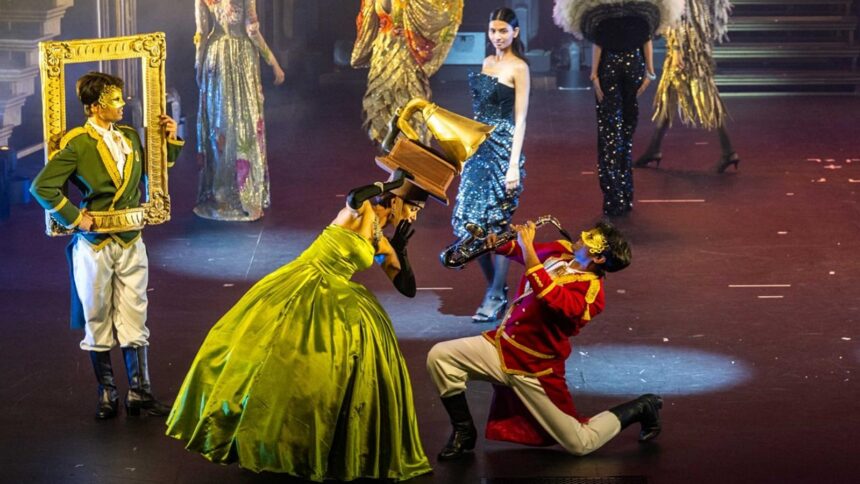
When the lights dimmed and the stage awakened, the theatre seemed to inhale collectively. Nearly a hundred dancers surged into motion — bodies blazing with purpose, patterns pulsing with precision. Screens shimmered like celestial windows, colours cascaded like cosmic confetti, and music rose with a rhythm that felt both ancient and urgent.
At one electrifying moment the chorus lifted a line into the hall:
“Seek the light beyond the noise.”
The lyric landed like a lighthouse beam cutting through fog. In an era overwhelmed by information — opinions, algorithms, accusations — clarity feels like a rare and radical act.
Then the tempo softened.
A quieter refrain floated through the theatre:
“Listen to the silence between the seconds.”
And suddenly the room stilled.
The choreography throughout the performance was astonishing — dancers darting, dissolving, and reassembling like living constellations. At times they resembled philosophers circling each other in debate. At others they became journalists wrestling with the restless roar of modern information.
Technology amplified the vision — vast LED environments unfolding like digital galaxies, immersive soundscapes swelling and subsiding like philosophical tides. Yet the beating heart of the production remained unmistakably human.
Breath.
Bone.
Body.
Watching the dancers move through these shifting landscapes, the metaphor of the tesseract began to breathe. A tesseract — a four-dimensional cube — is a form we cannot fully perceive from a single perspective. One must move around it, reconsider it, see it again.
Truth, the production suggests, behaves the same way.
Which makes the identity of the presenter particularly intriguing.
The institution behind this exploration of truth is the Times of India, one of the largest newspapers in the world — a publication whose daily mission has long been to report reality.
Yet here was that very institution staging a theatrical meditation on the nature of truth itself.
At first glance it feels paradoxical.
But perhaps it is precisely the opposite.
Because the show does not accuse journalism; it honours its deeper calling.
In one striking sequence a lone figure representing the journalist stands surrounded by dancers swirling in chaotic motion — rumours racing, facts flashing, opinions colliding, misinformation multiplying. Headlines flicker across the stage like restless birds.
And then the music rises again:
“Truth is alive when we dare to ask.”
The line rings through the theatre like a civic summons.
Truth, the production reminds us, does not belong to journalists alone.
Journalists investigate.
.
Artists illuminate.
But citizens must participate.
In a democracy, truth is not delivered like a daily newspaper. It is discovered — patiently, persistently, collectively.
And there was another quiet moment last evening that deserves mention.
Among the audience sat Anant Goenka, my publisher at the Indian Express, alongside his gracious wife and his formidable, remarkable mother. The three of them had come not merely as spectators but as fellow custodians of a craft — journalism.
Their presence carried a quiet message: that camaraderie in journalism is not contradiction but strength. That acknowledging, admiring and celebrating the work of a fellow publisher — even one from a rival house — is not weakness but wisdom.
In a profession too often fuelled by rivalry, last evening reminded us of something refreshing.
Respect still exists.
And respect is the soil in which truth grows best.
So here I am, writing this reflection in the pages of the Indian Express, grateful not only for the spectacle of Tesseract but also for the spirit of generosity and expansiveness that surrounded it.
Grateful to Anant Goenka for the largeness of mind that journalism demands.
Grateful to my editor Raj Kamal Jha, whose courage to think deeply is matched only by his insistence that we write fearlessly.
And grateful to Nandgopal Rajan — Nandu, whose editorial instincts remind us daily that journalism must never shrink itself into safety.
Because if last evening taught us anything, it is this:
Small thinking shrinks societies.
Big thinking builds them.
The production becomes darker as it approaches the present moment. appears not as villain but as mirror — reflecting the ambitions and anxieties of human invention. Climate change gathers like a slow storm over the choreography.
The dancers move faster now, their formations fracturing and reforming like the frantic pulse of the modern world.
Then something shifts.
Gradually the dancers begin moving together — no longer scattered individuals but a synchronised community. Their bodies bend and breathe like an accordion of time, expanding and contracting with eerie elegance.
The theatre grows silent.
And a final line rises from the score:
“Truth begins when we begin together.”
It is a sentence both hopeful and humbling.
Because it reminds us of something democracy too often forgets.
Alone we falter.
Together we flourish.
Late last night, long after the curtain call, I returned home to find my house buzzing with young minds — thinkers, dreamers, questioners. And the first thing I said to them was simple:
“I wish I had taken all of you.”
This morning I arrived in and said something similar to my mother.
She is eighty-one and one of the rare people of her generation who knows exactly what a tesseract is. She has spent decades devouring science fiction — the stranger, the sharper, the more speculative the better. Long before the word became fashionable, she was travelling through other dimensions through books.
As I described the dancers, the music, the stage bending time and truth into a living puzzle, she smiled with the delight of someone who has always believed that imagination is humanity’s most powerful tool.
And perhaps that is the real challenge of a production like Tesseract.
How do we carry its ideas beyond the theatre?
How do we bring that sense of possibility to cities like Delhi, to homes, classrooms, newsrooms and conversations?
Perhaps the answer is simple.
We talk about it.
We write about it.
We share it.
We remind ourselves that truth, like imagination, grows stronger when it travels.
For that reminder — and for an evening that transformed spectacle into reflection — I find myself deeply grateful to Vinay Mishra for insisting we attend, and to the Jain family for sharing their inspiration with the city.
Because sometimes the greatest privilege is not wealth or influence.
It is the chance to sit together in a dark theatre and remember that truth, democracy and imagination are not solitary pursuits.
They are things we must build together.
Otherwise, we all falter.