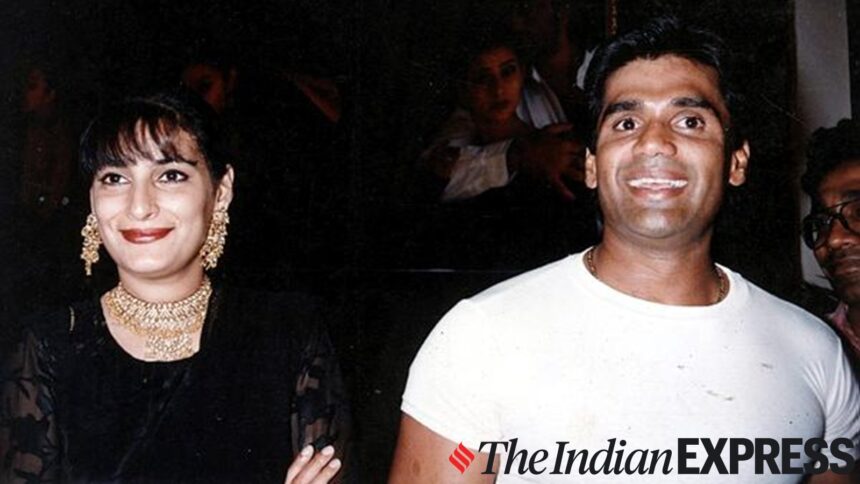
In a heartwarming conversation, Suniel Shetty opened up about his wife Mana, whom he married after a long wait owing to opposition from his family. “They didn’t want anything outside of the . And they believed, different cultures won’t fit in,” he spoke about Mana, who converted to Hinduism from Islam on her marriage to Suniel in 1991.
Recollecting his father’s first meeting with Mana, Suniel said it was not pre-planned. “Once Mana came to drop me at the airport for my first film, as I was going away for 60 days. I never expected Dad to come and drop me off, too. He says, I am coming to the airport to drop you off! I had already committed to Mana. And then he met me. Saw me. He saw her. He went and spoke to her… took her home, and that was the day… and I think 60 days after that… she had to go home and with him every day. So, somewhere it’s the father who understands.”
Expressing opposition from his side of the family, Suniel shared that he had a close relationship with her parents. “For 9 years they said, you won’t be happy, she won’t be happy…We never discussed it. They said no. But I was very clear about one thing…if you want me to marry someone else, it’s not going to be possible because I don’t want to destroy two lives, including my own. I won’t get married. As a guy, for me, it was still okay. Tough for her because her parents had accepted me. Her mother and I were a house on fire. I learned so much in life from that lady – the art of giving, the art of living, CSR, public, and working with people. She’s the one who taught me everything.”
So, what changed? “Time is the biggest healer. My parents saw the fact that their son was sincere; they didn’t know if it would last with her, but when they realised that a girl had given up everything for their son, what better partner could they look for? I wasn’t doing anything to them. I said, I won’t get married. Neither of us will get married. So, we are not hurting you at all. I believed in her completely,” shared Suniel in a conversation with Raj Shamani on his podcast.
Describing Mana’s qualities, Suniel shared that she has always been about “giving”. “She was only giving, and even today, she is only about giving. I don’t bother about anything in the house. For even minute things, right from whether my nails have been cut or my toothpaste is over, or my brush needs a change, she’s aware of it. It’s unbelievable. It’s insane. And she was like that, that time also. Not only me…whether it is Ahaan, Athiya, whether it is my mom or dad…dad and she were a house on fire… she is like a child, back then she was like a child…she is very expressive….we come from a family which is reserved…she is very physical…so she became physical with dad, mom, the chirpiness, the energy of hers, spontaneously responding, appreciating everything, i think probably (my dad) also hadn’t seen it….he was working from age of 9…how many of us have appreciated him…she brought about appreciation…”
Family objections in India are rarely about dislike alone. They are about fear. “Fear of cultural mismatch. Fear of . Fear that different values may create long-term friction,” described Delnna Rrajesh, psychotherapist and life coach.
What stands out in such journeys is not rebellion, but clarity. “Choosing to wait rather than elope. Choosing not to marry someone else to appease family pressure. It reflects emotional integrity. True maturity is understanding that compliance does not equal peace,” expressed Delnna.
Another important element in this narrative is patience.
Nine years is not impulsive love. “It is sustained commitment. It demonstrates that attachment is not built on drama but endurance. When love survives social pressure without bitterness, it earns credibility,” shared Delnna.
Another powerful layer here is appreciation. In families where emotional expression is limited, the entry of someone who openly appreciates, expresses affection and responds spontaneously can transform dynamics. “Many older parents grew up without overt praise or physical warmth. They equated love with provision, not expression. When someone new brings visible gratitude, acknowledgement and emotional openness into the household, it can feel unfamiliar at first. But over time, it humanises relationships,” said Delnna.
Psychologically, appreciation is one of the strongest relational healers. It shifts focus from what is lacking to what is valued. It disarms defensiveness. It builds trust.
Lessons we can learn
*If families object, respond with steadiness, not hostility. “If you believe in your partner, demonstrate it consistently over time,” said Delnna.
*Time does not heal everything automatically. But time, combined with sincerity, often changes perception.
*The strongest relationships are not those that faced no opposition. They are the ones who navigated opposition without losing respect. “Love is not proven by defiance alone. It is proven by endurance, integrity and the refusal to hurt others in the process,” said Delnna.