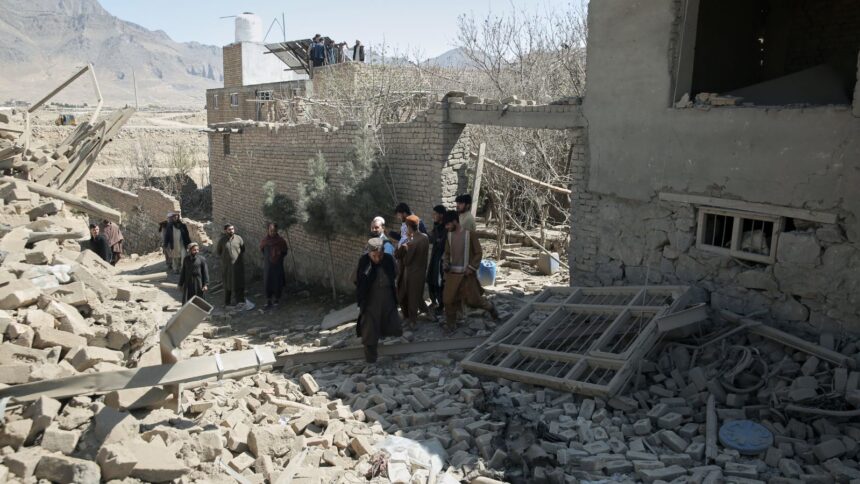
Pakistan-Afghanistan War News Today: Follow Live Updates HereA hospital for drug rehabilitation. Around 400 people reportedly dead — most of them patients. That is the grim picture emerging from Kabul after Monday night’s airstrike that Afghanistan has accused Pakistan of carrying out the attack.
Afghanistan’s deputy government spokesperson Hamdullah Fitrat stated on X that the strike hit the Omar Addiction Treatment Hospital around 9 PM local time. The alleged Pakistani attack destroyed large sections of the 2,000-bed facility, with the death toll reaching 400 and roughly 250 others injured. Sharing a picture of a charred hand, presumably from the attack, Fitrat said on X: “The hospital of hope that turned into a slaughterhouse of dreams.”
The Pakistani military regime carried out an airstrike at approximately 9:00 PM this evening on the Omid Addiction Treatment Hospital, a 2,000-bed facility dedicated to the treatment of drug addiction. As a result of the attack, large sections of the hospital have been destroyed,…
— Hamdullah Fitratحمدالله فطرت (@FitratHamd)
Pakistan, however, flatly denied the allegation. Prime Minister ’s spokesman Mosharraf Zaidi dismissed the allegations as baseless, insisting no hospital was targeted in Kabul. Pakistan’s Ministry of Information said the strikes “precisely targeted military installations and terrorist support infrastructure”.
The fighting began in late February after Afghanistan launched cross-border attacks in response to Pakistani airstrikes inside Afghanistan that Kabul said killed civilians. Those clashes also disrupted a Qatar-brokered ceasefire from October, one that had halted earlier fighting that killed dozens of soldiers, civilians, and suspected militants.
The roots run deeper, though. Pakistan accuses Afghanistan of providing safe haven to the — designated a terrorist organisation by the United States — as well as to outlawed Baloch separatist groups whose fighters regularly target Pakistani security forces and civilians. Kabul has repeatedly denied the allegations.
Things boiled over when Pakistani President Asif Ali Zardari said Afghanistan’s Taliban administration crossed a “red line” by deploying drones that injured civilians inside Pakistan. That triggered a chain of retaliatory strikes that has grown deadlier by the day.
Pakistan has since declared it is in — a phrase that, coming from a nuclear-armed state, carries enormous weight.
The Taliban-led government in Kabul isn’t backing down. Afghan government spokesman Zabihullah Mujahid condemned the hospital strike as a “crime against humanity,” saying Pakistan had once again violated Afghanistan’s airspace and targeted a civilian medical facility.
On the international front, the pressure is mounting – but slowly. China’s special envoy spent a week mediating between the two sides and urged an immediate ceasefire. The UN Security Council passed a unanimous resolution condemning terrorist attacks emanating from Afghan territory – without naming Pakistan – while extending the UN political mission in Afghanistan, UNAMA, for three months.
Neither side appears to be listening.
This isn’t just a bilateral spat. The conflict has alarmed the international community, particularly because the region also allegedly houses to al-Qaeda and the Islamic State groups, both of which have been attempting to resurface. A full-blown war between Pakistan and a Taliban-controlled Afghanistan would create a security vacuum that extremist groups would be all too eager to fill.
Both countries share a volatile, porous 2,600-km border. Millions of Afghan refugees live in Pakistan. And a protracted conflict could destabilise South Asia in ways that extend far beyond the two combatants.
For now, the bodies are still being pulled from the ruins of a Kabul hospital. And the ceasefire calls keep going unheeded.