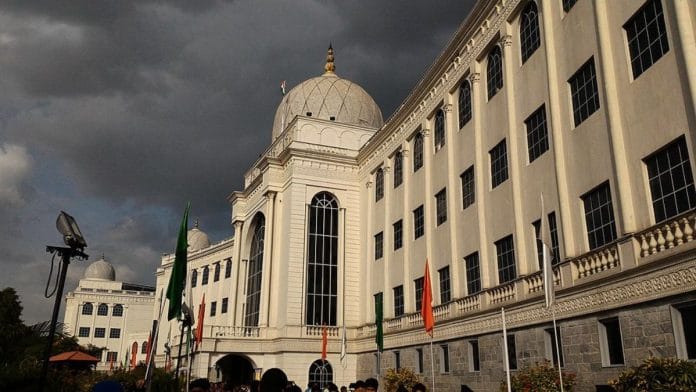
So, why bring this up now? Because 2026 will mark the 75th anniversary of the museum. The Salar Jung family’s collections were turned into a museum because of the rare art objects brought from all over the world over the centuries.
The family’s history goes back to the time of Hyderabad’s founders, the Qutb Shahi kings of Golconda (1518-1687). Later, when the Mughals conquered the city in 1687 and installed the Asaf Jahi Nizams as governors of the Deccan plateau, the Salar Jung clan came into prominence.
While Turab Ali Khan received the title Salar Jung (roughly translating to leader or commander of war) after becoming the Prime Minister of the erstwhile Hyderabad state under the fourth Nizam, two of his ancestors also held the same title twice before him. In total, five members of the family served as PMs in the state.
The last one, Mir Yousuf Ali Khan, Salar Jung III, was appointed as the Prime Minister of Hyderabad state in 1912. He, however, relinquished it very soon in 1914 and instead dedicated his life to collecting and enriching his art treasures till he was alive in 1949.
Salar Jung III was quite popular in Hyderabad. His ancestral palace, the Dewan Deodi, was apparently full of different things collected from all corners of the world. The man also had agents abroad who would send him catalogues and lists from antique dealers, building up the massive collection of articles and art.
However, while many call it the largest one-man collection (of Salar Jung III), the collection in the museum is more than that. The Veiled Rebecca by Giovanni Maria Benzoni, for example, is one of the most prized possessions. It was acquired by Salar Jung I, among thousands of other artefacts.
In fact, the Salar Jung Museum also has one of the best manuscript collections. Among other things, it has collections of Dakhni literature—the classical literary form of the Deccan region. It is generally difficult to find. A friend and a scholar pointed out that its collection also consists of ‘Kitab-i-Nauras’ by Ibrahim Adil Shah II of the Bijapur Sultanate (contemporary of Golconda).
This year, to mark its 75th anniversary, the Salar Jung Museum’s proposed conference is featuring some of the best historians in the country. Hyderabad, a city with rich history and culture, for some reason, is never active intellectually the way it should be. Hyderabadis, I love my city, and don’t kill me for saying that, but I think we can do better.
And the conference that the museum administration organises will hopefully galvanise us to perhaps do things better and be more involved with the city.
And for those of you who don’t know, the Salar Jung Museum has 40 galleries, like the Founders Gallery, Veiled Rebecca Gallery, Modern Indian Paintings, French-African Gallery, European Clocks, etc, all of which contain artefacts and artwork from across the country and the world.
Salar Jung III was a bachelor, and when he died, the family’s entire collection was left without an heir. He had no descendants. According to one of his paternal side descendants, the Indian government had asked Yousuf Ali Khan’s two brothers to take over the estate.
However, they chose not to. It then went to the maternal side. That is how there were eventually 114 claimants of the Dewan Deodi. While the central government opened up the palace as a museum after Khan died in 1951, the administration and artefacts were eventually handed over to the central government formally via a board.
A new building was erected for the museum, which is where it still stands, and the original museum of Dewan Deodi was handed over to the claimants, who demolished the beautiful palace estate.
(Edited by Saptak Datta)