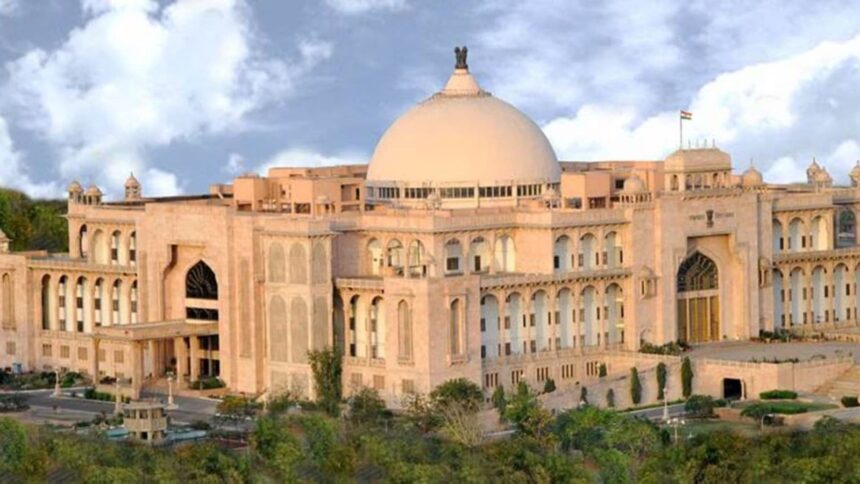
passed the Disturbed Areas Bill through voice vote in the Assembly on Friday amid intense opposition by Congress and some other MLAs who said that the law will create divisions within the society and strike at communal harmony in the state.
Replying to the debate on the Bill, Law and Parliamentary Affairs Minister Jogaram Patel said that the bill does not mention Hindu, Muslim, specific class, majority, minority, sect, community, or method of worship. “For us, everyone is equal. This Bill was drafted based on the state’s current circumstances, needs, and suggestions received with the advice of legal experts,” he said.
He said that the implementation of the Bill will further strengthen brotherhood and social harmony in the state. “It symbolizes social justice, security, and constitutional balance,” he said, adding that he will strive to maintain the Ganga-Jamuna culture in the state. He also said that this Act will play an active role in situations of tension, instability, and social unrest.
The Bill empowers the government to designate as a Disturbed Area if there is an “improper clustering” of persons of a community. Such a designation empowers the government to regulate the sale and purchase of properties in the said area, with provisions for imprisonment and fines for violation of the Act.
Patel said that riots and communal tension rapidly change the population structure in affected areas, creating an atmosphere of social imbalance and mutual distrust. He added that the increase in the number of a particular community in many areas of the state has impacted mixed population areas, leading to demographic imbalance, communal tension, and lack of public harmony.
Congress MLAs attacked the Bill mainly as being part of the “Gujarat model”, with both Congress and other independent and smaller party MLAs saying that it will vitiate the communal harmony and is being brought to appease a section of electors. Terming it as unconstitutional and as encroaching on citizens’ rights, they also raised questions on various terms in the Bill, such as improper clustering and ‘disturbed’ areas, asking how these would be defined. They also said that sufficient laws already exist to deal with law-and-order situations.
Congress state president Govind Singh Dotasra said that Rajasthan is a “very peaceful state” and that the Bill has been brought solely because such a bill already exists in Gujarat. He said that the government wants to vitiate the atmosphere in a bid to corner the majority’s votes by targeting a community. “You’re trying to isolate a specific community. This will cause irreparable damage to brotherhood. You want to destroy our Ganga-Jamuni culture. Hindus, Muslims, Sikhs, Christians, all live together in brotherhood. You can see it today and I understand you want to tarnish that too.”
“Young people will face discrimination in jobs, and people will be unable to get married if they live in a ‘disturbed’ area and people won’t marry their daughters there,” he said, asking what does the government mean when it talks of samuday vishesh (particular community), and whether Hindus can be considered samuday vishesh too. He also accused the government of planning to take over private land through the Bill, which will only “escalate disputes and exploit property owners.”
He also criticised what he said was administrative overreach over private citizens’ land and that it will “open the floodgates of corruption,” while questioning how the government plans to consider an area as disturbed, and that the Bill doesn’t clearly mention if “there will be data, or a survey,” to designate an area as disturbed.
Dotasra said that there are sufficient laws to deal with law and order, tenants, etc. and that this “copy- paste” of Gujarat model should be stopped, announcing that the Congress government will repeal the Bill once it returns to power in 2028.
Congress MLA Dungarram Gedar too said that for the last decade, the government has been dominated by “Gujarati companies, Gujarati contractors, Gujarati laws,” which are being operated by two persons. He said that the Bill “is going to create chaos, evictions, disrupt social harmony, and promote communalism.”
He said that the government mentions “demographic imbalance” but hasn’t clarified the criteria to define it. “Do you consider caste? Do you consider class? Will you consider religion? Will you consider gotra? Where people of the same caste live in large numbers, they fight over gotra. Where people of different castes live, there are frequent conflicts within castes. Where members of the same family live, there are frequent conflicts within families,” he said, adding that it will lead to officials arbitrarily designating areas as disturbed. He also questioned “improper clustering”, asking who will decide that clustering of people living in an area is improper.
Congress MLA Rita Choudhary said that the Bill mentions “intensity of violence” and asked how will the government measure such an intensity.
She said that the government is pursuing its “political agenda” and wants to take it to the elections “by constantly inciting conflict between two groups and arousing Hindu-Muslim, temple-mosque sentiments. The government is setting the notification period for a disturbed area at three years at a time, while simultaneously claiming it can be indefinite. If the government is unable to restore peace in that special zone, it is a failure of the government, not the fault of the public. This is the government’s job: if there is violence or unrest, you have to resolve it.”
Congress MLA Lalit Yadav said that the Bill “is a blatant attack on the fundamental rights of the people,” and that it will lead to communal division, “If the government truly wants to establish social harmony, it should focus on measures such as riot prevention, police reforms, speedy justice delivery, and social dialogue, rather than focusing on citizens’ property.”
Terming it as “unreasonable and unnecessary,” Congress MLA Narendra Budaniya too attacked the “Gujarat model”, saying that the government has brought the bill with elections in mind. He said that the government “intends to misuse it to suppress political opposition.”
Congress MLA Amin Kagzi said that among all the laws in Rajasthan’s history, “this bill is the most dangerous, which is going to shame and tear humanity apart. This bill which divides Hindus and Muslims will take the differences among our people to such a level that we cannot even imagine.”
“The stubbornness with which the Rajasthan government wants to bring this law, they did not ask their conscience as to what kind of law do we want to bring?” he said.
Congress MLA Harish Choudhary said, “The government knows exactly what it’s aiming for. The objectives and reasons for this bill include demographic balance and improper grouping.” Congress MLA Harimohan Sharma said that the state needs to learn from the law’s after-effects in Gujarat and that the state could not maintain law and order.
Posting on X, former CM said, “It is most unfortunate that in an attempt to conceal its political failures, the BJP government has brought in the Disturbed Area Act, pushing a peaceful state like Rajasthan towards an atmosphere of hatred. Such a divisive law deserves outright condemnation.”
BJP MLAs
Giving an example of Baghpura village in her native Rajsamand, BJP MLA Deepti Kiran Maheshwari said that people from a particular community started with 10 families and gradually grew to 200 families today. “There’s pressure to sell our property to one community and then move elsewhere. I want to ask you: if the government is safeguarding those properties, if the Collector’s intervention is being implemented, and if that intervention is allowing them to sell their properties even at the DLC rates, what’s the problem?”
“I want to make this point here: riots anywhere aren’t good. When riots occur and migration occurs, this Bill is meant only to safeguard those properties; (it is not being brought) for any one community,” she said.
She said that “uncontrolled property transfers have led to situations of ghettoisation and conflict in many places, where one community establishes excessive dominance. This situation exacerbates social polarisation and increases the potential for future tensions and riots, which is precisely what this Bill will address,” she said.
BJP MLA Balmukund Acharya said that there has been an exodus of lakhs from Jaipur’s old city. “The streets of Jaipur bear witness. The walled city of Jaipur, where the azaan and aarti were once heard simultaneously, is changing today; only the azaan is heard. Temples are locked. The countless temples that remain locked are a living example of this.”
He said that the Bill “will serve as a shield in the future, protecting the peace of Rajasthan from experiments like love jihad or communal polarisation,” adding that “this bill is not against any caste or religion, but it is against fear.”
BJP MLAs Gurveer Brar and Srichand Kriplani raised the issue of exodus from and Kashmir and other places.
Citing villages in Mewat, BJP’s Mahant Balaknath said that the MLAs should visit each village “and find out how many Hindus were on the voter list 15 years ago and how many Hindu families live there today. You will discover what is happening there on the ground.”
What others said
Independent MLA Ravindra Singh Bhati said that, “There’s only one reason for bringing this bill: how to spread animosity. How to instigate conflicts based on religion and caste, so we can easily win. This isn’t only the ruling party’s concern; the opposition is also in the same position… Today, our state, our country, has reached the point of civil war. Brothers are thirsty for each other’s blood.”
BSP MLA Manoj Kumar said that “If there are protests, riots, violence, and fights, what right does the government have to seize property? Maintaining law and order is the government’s job and property shouldn’t be seized for this reason.”
He said that there are areas in Jaipur with properties worth crores which can be declared as disturbed, forcing homeowners to sell them for a pittance to brokers who will be in connivance with officials.
RLD MLA Subhash Garg demanded that the Bill should be sent to the Select Committee. “Name one country in the world where brotherhood has been disturbed, where mutual harmony has been disturbed, has that country achieved progress? It has fallen behind,” he said.