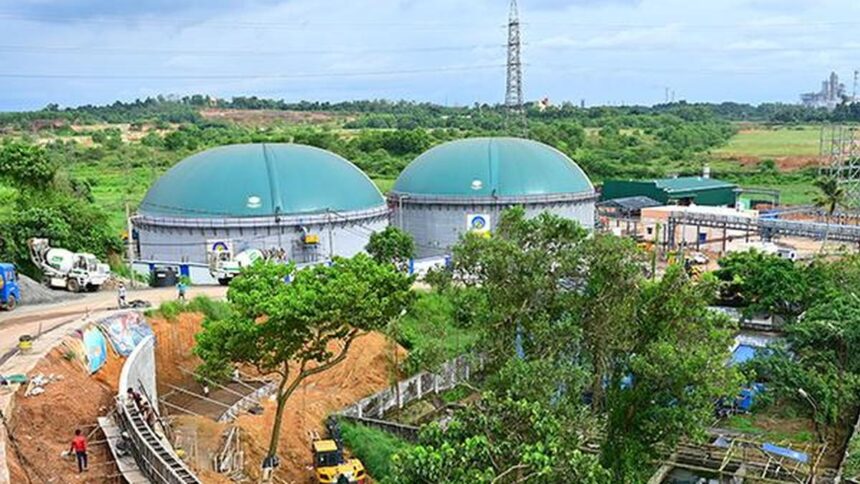
Petronet LNG is stepping up its diversification strategy with a ₹1,200 crore investment in compressed biogas (CBG), marking its entry into domestic renewable gas production even as geopolitical disruptions highlight the risks of relying heavily on imported liquefied natural gas (LNG).
The company has signed a binding term sheet with Gruner Renewable Energy to establish a joint venture that will set up 10 CBG plants, each with a capacity of 18 tonnes per day. The proposed venture, structured with equal 50:50 ownership, will require an estimated investment of ₹1,200 crore and represents Petronet’s first major foray into large-scale domestic gas production. While the regulatory filing disclosed the broad framework of the partnership, plant locations and commissioning timelines are yet to be announced.
Musk says SpaceX raised $40 billion in debt deal, predicts neocloud shakeout
The move comes at a time when Petronet’s core LNG business has faced supply-side headwinds. LNG throughput at the company’s flagship Dahej terminal declined to 192 trillion British thermal units in the April-June 2026 quarter from 207 trillion units a year earlier, as disruptions linked to restrictions around the Strait of Hormuz affected Qatari gas supplies. Spot LNG prices also surged sharply during the period, highlighting the vulnerability of import-dependent energy businesses to global market shocks.
Once fully operational, the 10 plants will have a combined production capacity of 180 tonnes of CBG per day, translating into roughly 63,000 tonnes annually, assuming 350 operating days. While modest compared with India’s annual LNG imports of about 25.5 million tonnes, the project offers Petronet a foothold in the emerging renewable gas market and an additional domestic revenue stream.
Samudra Manthan: Govt to partially underwrite drilling risks; operators to retain operational responsibility
The biogas venture, however, remains relatively small compared with the company’s larger expansion plans. Petronet is investing ₹20,685 crore in an integrated petrochemical complex at Dahej and is developing the ₹6,355 crore Gopalpur LNG terminal, which will increase regasification capacity by nearly 18 per cent to 32.5 million tonnes annually.
The CBG business could also benefit from policy support. Under government mandates, city gas distribution companies must blend compressed biogas with transport CNG and household piped gas, with obligations rising from 3 per cent in FY27 to 5 per cent from FY29. For Petronet, the challenge will be executing a business model that depends not on sourcing LNG cargoes from overseas, but on securing a steady supply of agricultural and organic waste feedstock across multiple locations.
Published on October 26, 2026