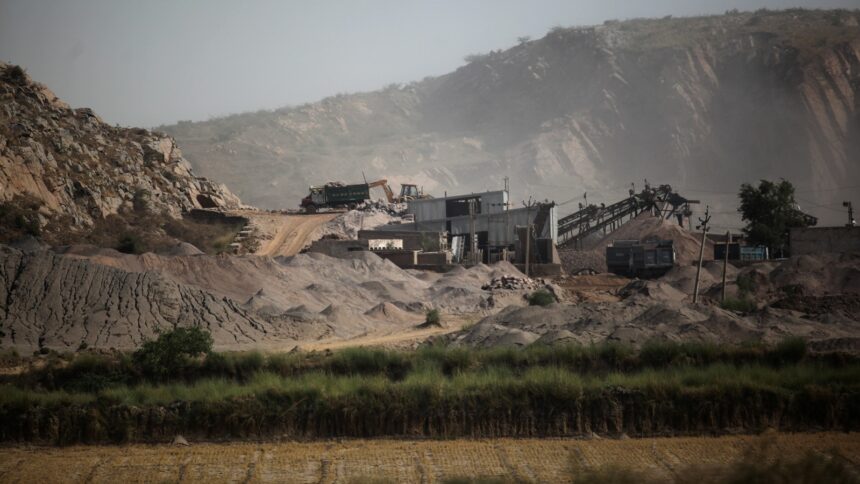
THE SUPREME Court’s has submitted that the report by the court’s Aravalli committee led by the Environment secretary “completely suppressed” the views of the Forest Survey of India (FSI) while for the hills.
The Amicus Curiae’s submission also pointed out that the “unsigned and undated” report of the Aravalli panel did not have the approval of the SC’s Central Empowered Committee (CEC) and its “exclusionary” definition did not “sufficiently include landforms that constitute the Aravalli hills in order to protect and conserve the same.”
On November 20, 2025, the SC accepted the recommendations of the Aravalli panel that any landform at an elevation of 100 metres or more above the local relief would be considered as part of Aravalli hills along with its slopes and adjacent land.
A series of investigations by The during November-December 2025 reported that the Aravalli committee ignored the FSI’s warning that a 100-metre height definition would exclude 90% of Aravalli hills, that the CEC’s objection to the definition was overlooked, and that the SC itself rejected the 100-metre benchmark in 2010.
Following “significant outcry among environmentalists,” the apex court took suo motu cognisance of the matter on December 29 and kept in abeyance its November 20 order “to subserve the ends of complete justice and in the broader public interest” until “a fair, impartial, independent expert opinion must be obtained and considered, after associating all requisite stakeholders.”
The apex court’s December 29 order also asked the Amicus Curiae and the CEC to assist in the case. Set up in 2002 by the SC, the CEC monitors and ensures compliance of its orders related to environment and forests. Amicus Curiae (friend of the court) are invited by the court to assist in specific cases with neutral and specialised legal expertise.
In his written submission dated February 24, amicus curiae K Parameshwar highlighted the key aspects of the case:
“Having a definition tailored only to mining purposes, ignores that the Aravalli range, although spanning across four different states, constitutes one contiguous ecosystem and ought to be treated as such. Any plan to conserve and protect the Aravalli range must comprehensively address the needs of the entire geographical feature as a whole,” the Amicus wrote.
Outlining the consequences of adopting an exclusionary definition, the Amicus pointed out that isolating only certain individual hills would result in fragmentation of a range, which in turn could adversely open up more areas for mining. At risk will be the lower hills, which play a vital role in combating desertification, hills which are more than 500 metres apart, and valleys and flat areas which form part of the Aravalli range.
Going forward, the Amicus suggested that the Indian Council of Forestry Research and Education (ICFRE) and FSI may be directed to conduct surveys of the entire Aravalli geomorphological region to identify and map key ecological corridors and aquifers.
Based on these findings, the Expert committee to be constituted by the SC may determine mechanisms to plan for conservation areas, mining, and other developmental activities within the contiguous Aravalli ecosystem, the Amicus note said.
On February 26, the SC asked the Amicus note to be circulated among the parties and called for names for setting up a committee of domain experts. The case will be heard again later this month.