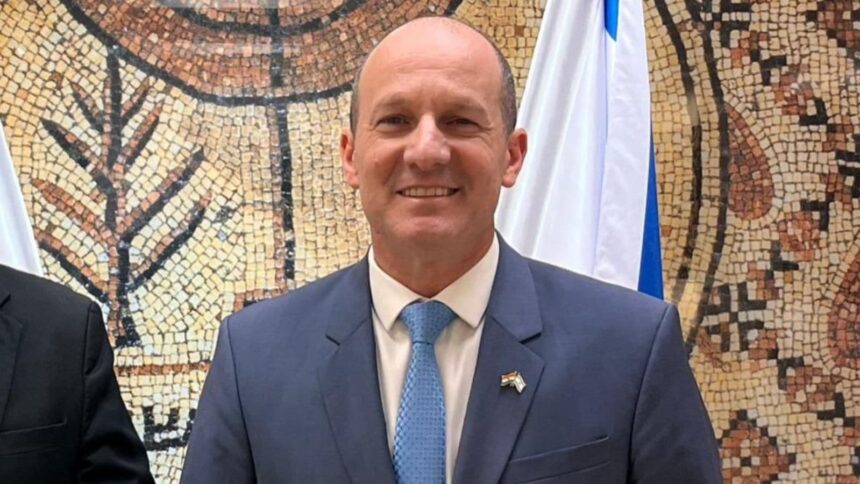
Israel’s strikes on Iran were conducted during an “operational opportunity” that arose last week, shortly after Prime Minister Narendra Modi departed from the country. This “right moment” for the strike came after years of significant investment aimed at enhancing Israel’s intelligence and military capabilities, Reuven Azhar, Israel’s Ambassador to India, told The Indian Express.
In an interview with The , Azhar said it was not known during PM Modi’s visit that these strikes on Iran would be undertaken. “It was an operational opportunity that came up only after Prime Minister Modi left. Of course, during the conversations with Prime Minister Modi during the visit, we talked about regional development, but we couldn’t have actually shared something that we didn’t know,” he said.
India and Israel had elevated their ties to a “Special Strategic Partnership” and signed 17 pacts after talks between Prime Ministers Narendra Modi and on February 26. Two days later, the United States and Israel launched an offensive against Iran.
Speaking about the planning and preparations that preceded the strikes, Azhar said Israel has been suffering from threats from Iran for decades and therefore it had to create the intelligence capability to understand the Iranian regime, their military machinery, and to have all the means necessary to know what they are intending to do next, including who are the people there making decisions, where exactly they are located, and all the capabilities that are threatening Israel.
“So, only towards that effort, we have invested billions of dollars throughout the years because of the nature of the threat,” he said, adding that Israel had to build up its military and develop the technologies that allow it to overcome the air defence systems of Iran.
“In terms of defence capabilities, we had to develop different systems to try to stop the barrage of missiles, ballistic missiles and rockets that were being fired at Israel, not only from Iran itself, but also from other countries where the proxies of Iran were residing,” Azhar said.
“So thankfully, we had prepared at the highest level. In addition to that, thanks to the Abraham Accords, we have been able to coordinate our military operations and the surveillance of the air of the Middle East, together with CENTCOM, the Central Command of the US Forces in the region,” he added.
“And now, before this operation, we’ve been coordinating with the United States for a long time and been waiting for the right moment (to attack the Iranian leadership), which we didn’t know when was going to happen,” he said.
Azhar said that Israel did not know when PM Modi was there that the operation would take place immediately after. “It took about two days after he left, and we took, of course, the approval of our security cabinet only on Saturday morning before we launched the operation,” he explained.
“It was basically, let’s say, an operational opportunity that we utilised as a result of the intelligence that came in real time,” he said.
Asked about the number of ballistic missiles and drones that were fired at Israel and how many were effectively intercepted, he said at this point, the exact number has not been made public due to security considerations.
“…But what I can tell you is that we have developed new systems, including Iron Beam, a laser defence system that now has helped us a great deal to deal with drone threats and also with the missiles and rocket threat,” Azhar said.
He, however, clarified that the system is not an answer yet to ballistic missiles, which are being intercepted with systems like Arrow 3 and David’s Sling (both advanced missile defence systems).
“Fortunately, most of them are intercepted. Unfortunately, some of them managed to penetrate, like we saw yesterday, with a terrible incident in which a civilian shelter was hit directly by a ballistic missile and caused the death of nine people,” he said.
Azhar further expressed hope that with the continuous action of the Israeli Air Force and the Air Force of the United States and other countries that will join the effort, “we will be able to degrade the ballistic missile threat more substantially than we did back in June.”
Azhar added that currently, the massive presence of the American Navy in the region has been a multiplier. This, he said, “allows us to hit not only the ballistic missile launchers, but also the production sites and the silos with very heavy bombardment that includes bunker buster capabilities that only the United States possesses.”
Delving further into Israel’s air defence capabilities in the face of ballistic missile and drone attacks from Iran, he said that when there is a need to manage an integrated air defence operation, you use all the means that you have at your disposal.
“It includes the Air Force itself. Because the Air Force, through the planes, can intercept some of the missiles. It includes the radars that are in charge of getting the information about the incoming attack. It includes the different layers of the defence, like Arrow 3, David’s Sling and at the end of the day, the combination, and, of course, other systems that are used against drones, like the Iron Dome and the Iron Beam.”
Highlighting the challenges involved in such air defence operations, he said at the end of the day, the challenge is to integrate all the systems in real time and decide in real time what is the tool that you are going to use, and that can actually give the most efficient result at the given second, and that actually requires sophisticated systems that include AI, real time analysis and trained officials that are sitting in the air defence operation rooms.
“It’s a very, very difficult task,” he said, also adding that Israel has different combat jet planes that were used in the strikes against Iran. “We have procured F-35s (American fifth-generation fighter jet), and we also have F-16s, and we have been using a combination of them for the attacks that we conducted over the skies of Iran,” he said.
Asked about his assessment of the endgame in Iran after the death of its Supreme Leader Ayatollah Ali Khamenei, he said: “We are not going to determine who is going to rule Iran in the future. It’s up to the Iranian people to decide.”
“What we have done is that we engage in a military operation to neutralise the threats that were against the existence of our country and also against the Iranian people, the military targets, the Basij targets, that would make the regime to be able to continue intimidating the public,” he said, adding it is now up to the public and the forces of Iranian opposition to decide who is going to lead the country and “what they’re going to do next.”
Asked about Israel’s ground involvement in the unrest in Iran that preceded the strikes, Azhar said, “Unfortunately, we didn’t have enough energy to help the Iranians more than we did.”
“I think that the Iranian people deserve freedom, and if they could get more help from the international community, that would be a worthy cause. Because the Iranian people deserve freedom. They deserve liberty. They deserve to free themselves from this terrible oppression that has been killing them, raping them, you know, abusing them for so many decades,” he said.
“I hope that we would actually be able to help the Iranian people more. But unfortunately, our resources are limited, so we are concentrating first and foremost on our right of self-defence and the usage of military capabilities to neutralise the threats that are coming from Iran,” he added. “And we hope that with the modest help that we have given the Iranians, they will embrace this moment to change the situation in their country.”