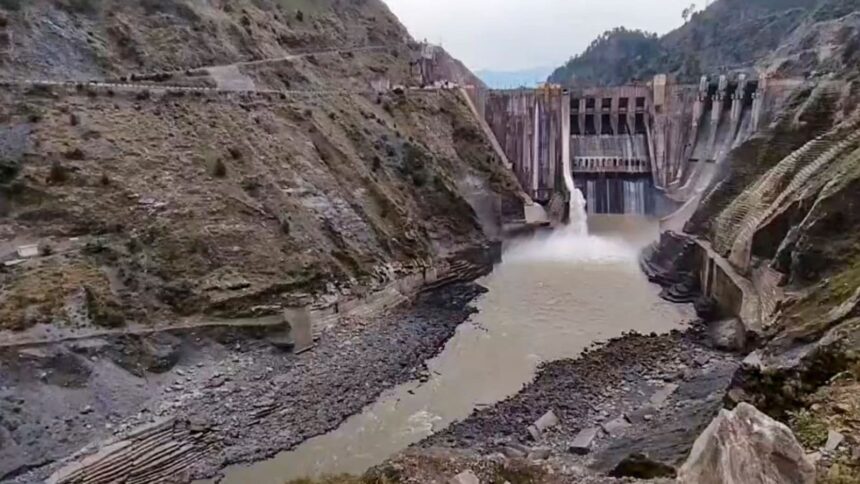
The has held Megha Engineering and Infrastructure Limited (MEIL) liable to pay the full cost of restoring the downstream riverine ecology of the Chenab River, damaged by illegal dumping of construction debris during the ongoing construction of 850 MW Ratle Hydroelectric Power Project in Kishtwar, Jammu and Kashmir.
The principal bench, in its judgment February 12 judgment, directed the Ministry of Environment, Forest and Climate Change (MoEF&CC) to constitute a committee of experts to assess restoration costs within three months, with MEIL bearing the expenditure. A bench of judicial member Justice Arun Kumar Tyagi and expert member Afroz Ahmad passed the judgment.
The NGT relied upon field visits and a factual report by a joint-committee of state, central and Central Pollution Control Board officials to examine the nature of alleged violations.
The tribunal also directed MEIL to explore using excavated muck to develop a biodiversity or forest park with the state’s Forest Department, modelled on the Kishanganga Power Project’s park in Bandipora. The expert committee must file quarterly action-taken reports with video recordings before the Registrar General, the NGT ordered. Meanwhille, Environment Ministry and the J&K Pollution Control Committee (J&KPCC) were directed to pursue penal action on environmental clearance violations under show-cause notices already issued.
The NGT was examining allegations of illegal muck dumping made in a November 2023 letter petition by te Municipal Committee of Thathri, a town in Doda district, situated at virtually zero distance from the Chenab. The petition alleged that MEIL, which was awarded the engineering, procurement and construction contract for the Ratle project in January 2022, was dumping excavated muck directly into the river instead of at three designated disposal zones approved under the project’s environmental clearance.
The applicant warned that rising water levels could devastate over a thousand shops and five thousand homes in Thathri during the monsoon.
The Ratle hydroelectric project is one of the most important power projects under construction on the Indus basin. In the years before India put the Indus Water Treaty in abeyance, Pakistan had challenged the project’s technical design features and alleged it violated the 1960 treaty. Earlier this year, Union Power Minister Manohar Lal had laid the foundation stone for the project’s 133 m high dam’s concreting work.
The NGT had constituted a joint-committee in September, and tasked it with visiting the site to submit a factual report. This committee comprised officials from Kishtwar, member secretary, J&KPCC, a scientist from MoEFCC and an official from Central Pollution Control Board.
The committee had submitted to the NGT that MEIL had dumped muck directly on the Chenab’s banks and allowed it to flow into the river, violating the environmental clearance condition requiring disposal sites to be at least 30 metres from the river’s high flood level.
One of the primary muck dumping zones on the river’s right bank was found to be closer than the 30 m threshold. Additionally, retaining walls built at these dumping sites did not comply with norms, and as a result, the muck was directly flowing into the river channel. The NGT took on record the committee’s status report, including the violations it found. In fact, it had also noted that photos in MEIL’s own counter affidavits showed direct discharge of muck into the river.
The Tribunal has also noted in its order that the Environment Ministry had already found that project activity was not complying with conditions imposed in the environmental clearance, including river dumping. The ministry had issued a show-cause in October 2024 to Ratle Hydroelectric Power Corporation Limited (RHPCL) on this issue. RHPCL had itself written to MEIL three times between 2022 and 2024, warning that persistent violations could attract penal action under the Water Act, Air Act and Environment Protection Act.