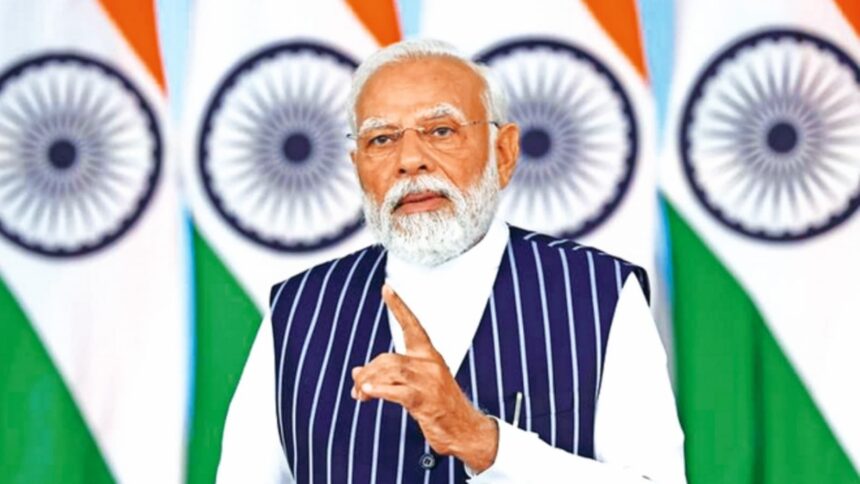
Expressing “deep concern” at the “current situation” in West Asia, Prime Minister Narendra Modi said on Monday that India supports the resolution of all disputes through dialogue and diplomacy.
After meeting the visiting PM of Canada Mark Carney, PM Modi said, “We will continue to work with all countries to ensure the safety of all Indian citizens present in this region.”
“The current situation in West Asia is a matter of deep concern for us. India supports the resolution of all disputes through dialogue and diplomacy,” he said. There was no reference to the killing of Iran’s Supreme leader Ayatollah Ali Khamnei in the statement or expression of condolences.
Modi’s comments came hours after he spoke to Prime Minister of Israel late on Sunday night.
“Had a telephone call with PM Benjamin Netanyahu to discuss the current regional situation. Conveyed India’s concerns over recent developments and emphasised the safety of civilians as a priority. India reiterates the need for an early cessation of hostilities,” Modi had posted on X, tagging @netanyahu.
Earlier, on Sunday night, he had said that India strongly condemned the attack on UAE and supported “de-escalation, regional peace, security and stability”.
Modi said this after a conversation with United Arab Emirates President Sheikh Mohamed bin Zayed Al Nahyan.
“Spoke with President of the UAE, my brother Sheikh Mohamed bin Zayed Al Nahyan. Strongly condemned the attacks on the UAE and condoled the loss of lives in these attacks. India stands in solidarity with the UAE in these difficult times. Thanked him for taking care of the Indian community living in the UAE. We support de-escalation, regional peace, security and stability,” Modi said on X.
The condemnation of the Iranian attacks by the Indian Prime Minister is an important signal that has chosen to speak in favour of the Gulf countries, which are India’s strong regional partners.
The UAE’s statement echoed and amplified this sentiment as it said that “Indian PM reaffirmed his country’s rejection of the blatant Iranian attacks on UAE territory & expressed India’s solidarity with the UAE in all measures it takes to safeguard its sovereignty, protect its security, & ensure the safety of its people”.
Indian expats account for 35 per cent of UAE’s population, and form its largest ethnic community.
Beyond the nine million Indians living in the extended West Asian neighbourhood, what frames India’s diplomatic challenge at this juncture are its own beliefs on sovereignty and territorial integrity, a complicated relationship with Khamenei over the last few decades, sensitivities of the domestic minority community, and evolving partnership with the US.
The CCS meeting was attended by Home Minister , Defence Minister , Finance Minister Nirmala Sitharaman and External Affairs Minister S Jaishankar, besides NSA Ajit Doval, Secretaries in the PMO, P K Mishra and Shaktikanta Das, Cabinet Secretary T V Somanathan, CDS General Anil Chauhan and Foreign Secretary Vikram Misri. So far, there has been no official statement expressing condolences for the Iranian leader.
After the CCS meeting, a statement said, “The Cabinet Committee on Security (CCS) met this evening under the chairmanship of the Prime Minister to review the evolving situation in West Asia.”
“The Committee was briefed on the air strikes in Iran on 28 February and the subsequent escalation, including attacks in several Gulf countries. It expressed serious concern over the safety and security of the large Indian expatriate community in the region,” it said.
“The CCS also reviewed the difficulties faced by Indian travellers transiting the region and students appearing for scheduled examinations, as well as the broader implications for regional security and economic and commercial activities,” it said.
“The CCS directed all concerned departments to take necessary and feasible measures to assist Indian nationals affected by the developments. It underscored the importance of an early cessation of hostilities and a return to dialogue and diplomacy,” it said.