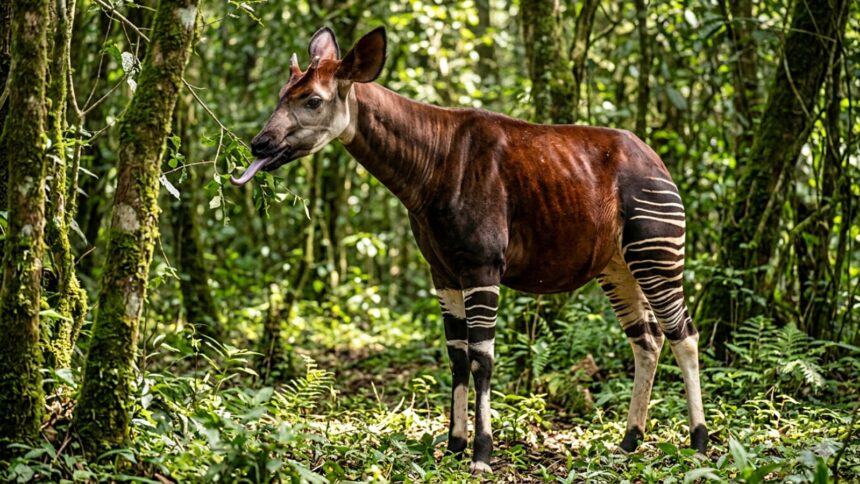
At first glance, it looks like someone combined two very different animals. It has the striped legs of a zebra, the long face of a giraffe, and the body of an antelope. Meet the fascinating Okapi — one of the world’s most unusual and mysterious mammals.
Often described as a “zebra–giraffe hybrid” (even though it isn’t actually a mix of the two), the okapi is a rare forest animal found only in the dense rainforests of the Democratic Republic of the Congo in Central Africa.
Despite its zebra-like stripes, the okapi’s closest living relative is actually the Giraffe. Scientists discovered this connection through anatomy and genetics.
Both animals belong to the same biological family, Giraffidae. Like giraffes, okapis have long necks (though much shorter than giraffes) and surprisingly long, flexible tongues that can grow up to 30 centimetres. The tongue helps them strip leaves from branches and even clean their own ears.
Those zebra-like stripes are not just for looks. The bold white stripes on an okapi’s hind legs help it blend into sunlight filtering through dense forest plants.
This natural camouflage helps the animal stay hidden from predators such as the Leopard. In fact, okapis are so secretive that they were largely unknown to the outside world until the early 20th century.
The species was first scientifically described in 1901 by British explorer and administrator Harry Johnston after local communities in Congo had long known about the elusive animal.
Okapis prefer living alone. They quietly wander through thick rainforest, feeding on leaves, fruits, fungi and buds from hundreds of plant species.
They also have an unusual communication style. Because visibility is low in dense forests, mother okapis and their calves use very low-frequency sounds — almost like whispers — that predators cannot easily hear.
Although okapis look strong and healthy, their population is under threat. The species is currently classified as Endangered by the
Habitat loss, mining activities and poaching in the Congo rainforest have reduced their numbers in the wild.
Protected areas such as the Okapi Wildlife Reserve play a crucial role in protecting these animals and their habitat.
The okapi remains one of the most unique animals on Earth — a creature that looks like a mix of familiar species but is actually entirely its own.
Part zebra, part giraffe in appearance, and completely mysterious in behaviour, the okapi is a reminder that the natural world still holds plenty of surprises waiting to be discovered.