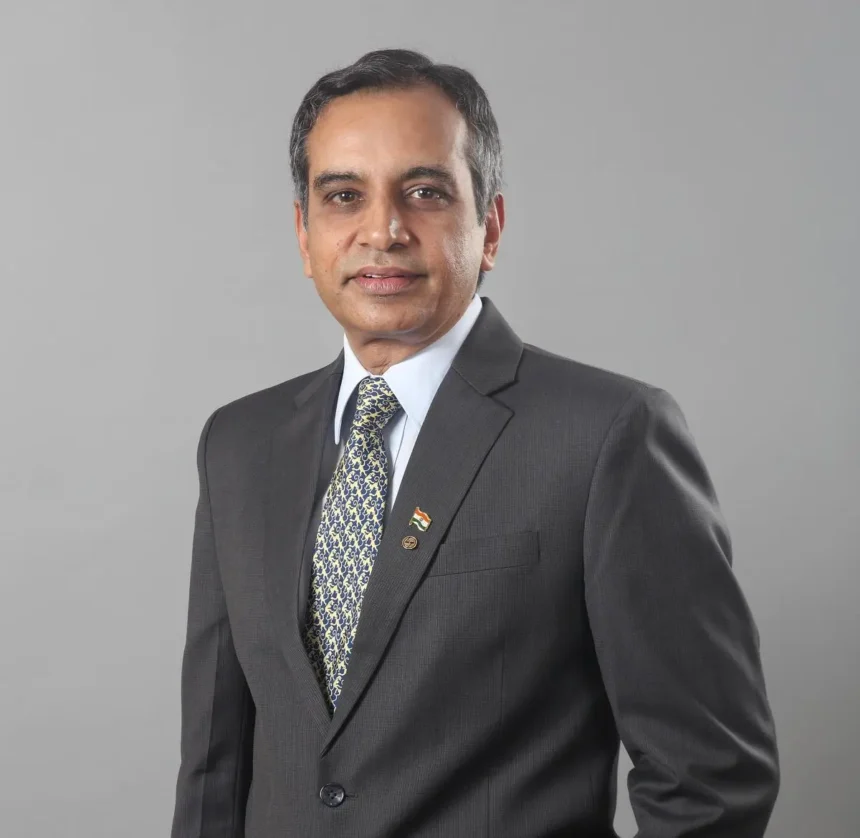
Larsen & Toubro aims to double its ₹8.5 lakh crore order book by FY31 by focusing on automation, investing in manufacturing capabilities, and expanding into new geographies such as Central Asia and Europe, the company’s President and Whole-Time Director (Finance), R Shankar Raman, said on Wednesday.
Project execution will remain a key focus amid inflationary pressures, and the company will continue hiring engineers to complete jobs more quickly, he added.
At present, the company’s business is split equally between India and overseas markets. Raman estimates that by FY31, India and West Asia will contribute 40 per cent each to its order book, and the remaining will come from new markets.
“If we continue growing 15 per cent year-on-year every year till FY31, our order book can grow to ₹15 lakh crore,” he said.
The company has stepped into Central Asia and is building an airport and data centre in Uzbekistan. In Europe, it is executing a ₹50,000 crore wind energy project. The company hopes to bag more orders from Europe and is also evaluating opportunities in Australia.
Raman said the company has 150 operational sites in West Asia and employs nearly 55,000 people. All projects in the region are operating normally including those in Saudi Arabia which is its largest market in the region.
Larsen & Toubro reported 28 per cent growth in order inflows in the second quarter of FY27, while net profit rose 33 per cent y-o-y. Margins came under pressure due to higher raw material and logistics costs, but Raman said the company is focused on increasing return on deployed capital and keeping the balance sheet healthy.
The company is focusing on developing automation solutions for its construction business. This includes introducing robots for welding, plastering, and painting. This will help the company maintain its competitive advantage, execute projects quickly, and address labour availability issues.
L&T’s overall workforce grew by 9,000 persons over the last year. The company continues to hire graduate engineers consistently and is also in discussions with educational institutions to develop curricula. “Today, there is a disconnect between skill availability and industrial requirements and that gap has to be bridged,” he said.
Published on October 28, 2026