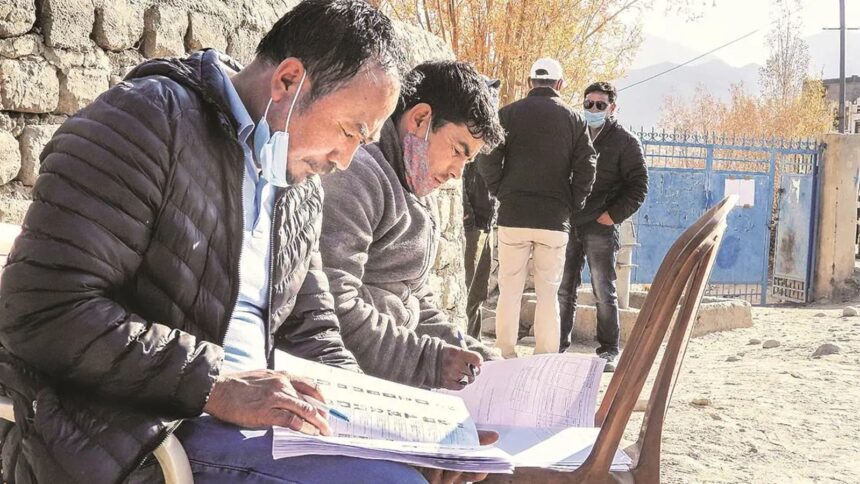
With the term of Jammu and Kashmir’s District Development Councils (DDC) having ended this week, all three tiers of the Panchayati Raj system are vacant in the Union Territory. With no immediate signs of a re-election to these bodies, J&K’s grassroots democratic institutions remain without representation.
A year after the abrogation of special powers under Article 370 of the Constitution and the restructuring of the former state of J&K into two Union Territories, the Centre amended the and Kashmir Panchayati Raj Act, 1989, to facilitate the setting up of District Development Councils, in which members are directly elected by voters.
During the period before the last Assembly election, when there was no elected Legislative Assembly in J&K, the DDCs were imagined as “mini assemblies” within each district. The DDCs replaced the District Planning and Development Boards in all districts with the task of preparing and approving district plans and capital expenditure. With 14 elected members per district representing its rural areas, the DDCs became the development delivery mechanism as part of a third tier of J&K’s Panchayati Raj Institutions.
Shafiq Mir, chairman of the All J&K Panchayat Conference, cited a lack of political will in conducting these elections. However, he said that without the necessary security clearances, no elections can be held and that therefore the buck stops with the Lieutenant Governor’s office. “The UT government is fighting for its own powers and demanding statehood. I do not see a will to push for these elections. However, security lies with the L-G, and without that clearance, elections cannot be held in J&K,” he said.
He also pointed out that PRIs are required for the implementation of several centrally sponsored schemes and in rural areas. “The lack of this delivery mechanism is being acutely felt,” he said.
On February 21, former bureaucrat Shantmanu was sworn in as the State Election Commissioner by Lt Governor Manoj Sinha. This is being seen as a positive development with regard to Panchayat elections. However, in the absence of any notifications, the future of these institutions remains unclear.
The term of J&K’s panchayats and Urban Local Bodies ended in 2023. Since then, no elections have been announced for either. On February 24, the term of the DDCs also ended, creating a grassroots vacuum.
The DDCs faced several challenges in their five-year term, including those of legitimacy under the bureaucratic control of the UT, as well as security concerns, with many having to remain in confined spaces under police protection in the initial years of their creation.
Many councils also faced internal strife with challenges to the chairmen in at least four such bodies by other members. Several members of the councils who spoke to The observed that “while the council itself failed to operate as a cohesive unit, a lot of developmental work was achieved through them”.