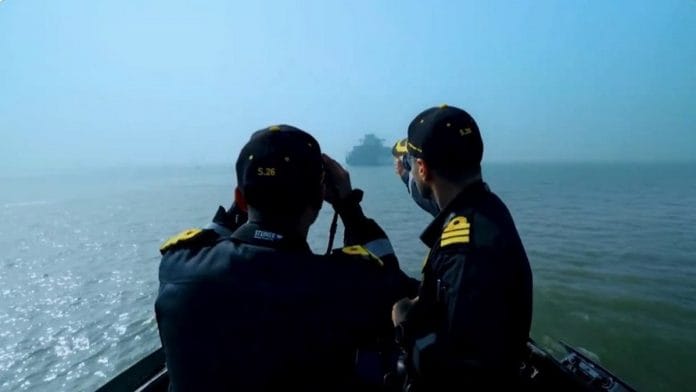
It is about time that a fourth player enter the field and provide the additional support for what are already very complex diplomatic, political, and commercial negotiations. There is a significant role the Navy can play in this situation, and now is the time for the Ministry of Defence to step forward and claim its space on the seas.
There is significantly more the Navy can do to contribute to India’s energy and economic security, having conducted endless flag visits to various Gulf countries over the years. The Navy has, in fact, been the epitome of military diplomacy, especially in the Gulf region. From aircraft carriers to various other advanced warships, the Indian tricolour has flown in numerous Gulf ports with sparkling whiteness. It’s time to don combats.
This is not to say that the Navy engage in combat operations in the Gulf, or even be seen to be taking sides in this pointless conflict. Far from it. What is important is that the Navy be seen on the high seas, protecting Indian interests, assets, and lives. After all, the armed forces of India exist to promote and protect national interests across the security spectrum, as determined by political authorities. The Navy has always been in the forefront of supporting national diplomatic and other outreach efforts beyond India’s political boundaries. Time to step up.
For starters, the Navy, along with the other services and the Ministry of Defence, could provide a ready reckoner on the combat operations underway. There is a requirement for an Indian analysis, and subsequently a limited-access briefing, on the nature of operations, their likely duration, and above all the military philosophy that governs the mindsets of the three belligerents.
Instead of relying on Western assessments, or those of armchair specialists, there should be a professional Indian military analysis of what the three think, how they are conducting operations, and how this is likely to pan out. Above all, help ascertain where Indian military interests lie.
On the morning after Israel claimed it had killed Ali Larijani, Secretary of Iran’s Supreme National Security Council, the United States lost the services of Joe Kent, the Trump-appointed Director of the National Counterterrorism Center. He resigned over differences with the conduct of the war on Iran, while Ali Larijani had virtually set the stage for how to mastermind a conflict that had been imposed on Iran. Israel and the United States of America, predictably, employ their military power based on a Western doctrine centred on the primacy of tonnage with selective decapitation. Completely at variance with eastern memories and core strengths.
In Iran’s case, surrounded as it has been over the centuries by non-Persian and anti-Shi’a forces, a power vacuum has always been a source of deep concern. The decline of Persian influence has been attributed to inefficient succession procedures over centuries, something that the post-1979 revolutionary state sought to correct. To a large extent the regime has managed leadership change with a remarkable degree of success, given the adversaries ranged against it. The decapitation of various leaders, therefore, is unlikely to produce the results Israel and the US expect. It may instead lead to a more decentralised decision-making system, making Iran militarily more unpredictable.
There is a certain identifiable pattern to Iranian targeting of military or other economic assets, or even supposedly civilian structures across the Gulf region. Ali Larijani had been about Iran’s need to prolong the conflict, signalling it had greater endurance than its Western adversaries. Thus far Tehran has gone along that path, sending missiles and drones in an unpredictable manner.
Such methods were anticipated nearly 30 years ago in a Beijing-published book on war-fighting in unequal situations— by Chinese Air Force officers Qiao Liang and Wang Xiangsui. It can be considered a manual for future wars. Something to begin with for an Indian analysis.
(Edited by Asavari Singh)