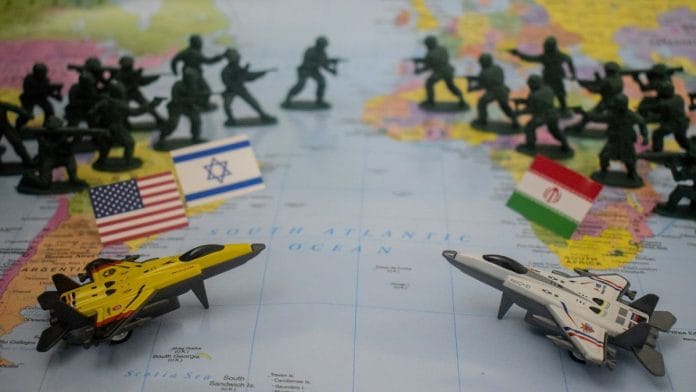
There was a time, not long ago, when Iran and Israel were partners, finding mutual benefit in cooperation. Israel even helped source American defence equipment for Iran, who learnt from Tel Aviv about drones against Soviet air defences in Syria.
The story that follows now seems to belong to another universe, but I’ll unwind it, showing how cooperation, competition, rivalry, national interest, ideology, and oil have rewritten the texture of war—all emanating from one Original Sin—the promise of Palestinian statehood.
No, don’t give up on it right away. Palestine might never have a state, yet its quest has been used, abused and exploited by everyone in the Gulf and the Levant—Arab monarchies, to the Ba’athists, to the Muslim Brotherhood—and by Israel itself.
We need a starting point to come back to the present. Let’s begin with the 1970s.
In the 1970s, the world looked different. Mossad (and the West) trained SAVAK (Shah’s feared intelligence service). In Tehran, lived the largest Jewish community in the Middle East. Jews looked upon the Persian kings as saviours and Iran—the only major non-Arab state in the Middle East—had close ties with the US, something like today’s strategic partnerships.
Then came the 1979 Iranian Revolution, and the Shah fled. Fifty-two Americans were held hostage for 444 days.
You’d think that ended Iran-Israel ties. Reasonable guess—but wrong.
Part of the reason was back-channel negotiations. The Ronald Reagan administration tried to get their hostages in lieu of weapons (sourced from Civil wars in Nicaragua) to the Ayatollahs—later exposed as the Iran-Contra Affair—a fascinating story of intelligence services “sleeping with your enemy”.
Then came the eight-year Iran-Iraq war from 1980 to 1988, where American and Israeli interests started to diverge.
Saddam Hussein, Ba’athist, ambitious, expansionist and hostile to Israel, dominated the Arab world. Israel saw him as a new Arab leader, a new Nasser in the making and decided to back Iran to counter Iraq. And soon, the best strategy was to prolong the Iran-Iraq war.
Here, the US-Israeli approach to the Iran-Iraq war sees a further drift.
The US wanted the hostages back and then to see the Ayatollah regime weakened. But Israel wanted a strong enough Iran to contain Saddam.
That was the era before Ayatollahs chanted death to Israel, even when they were chanting death to America.
Israel supplied Iranians spare parts for Iran’s 200 F-4 Phantom fleet, acquired during the West-friendly regime of the Shah and even sent their own Phantom fleet engineers to keep the Iranian fleet flying. Meanwhile, the Gulf Monarchies backed Saddam against the Shia Iran, in line with the USA.
And the Palestinian cause? Largely sidelined.
Run down by the long asymmetrical war—a drain on both sides, more so on Iran—the Iranians take up the Palestinian question as a tool of influence across local populations—both Shia and Sunni—in the Gulf and Levant.
This coincided with the First Intifada (1987), and Iran’s support for the Palestinian cause and the rift with Israel begin to deepen.
The rift also co-develops with the changing nature of Israeli domestic politics—fueled by much more geopolitics than we care to remember today.
I will return to the shift in a bit.
For Iran, a right-wing, nationalist Israel becomes an enemy, and they create Hezbollah, the first proxy on the border of Israel in Lebanon. Soon, Hezbollah becomes the driving force in the Lebanese civil war, as waves of Palestinians displaced from the West Bank in successive wars from 1948 to 1967 to the Yom Kippur in the 1970s—poured into Lebanon, Iraq and Jordan.
A technical detail needs to be underscored.
Even as Iran relied on Israeli-sourced spares for its F-4 Phantom fleet in the early Ayatollah years, it closely analysed Israeli early drone tactics—especially their saturation against Soviet air defences in Syria under Hafez al-Assad.
Iran learnt the tools of asymmetric warfare and developed its own Ababil-1 in the early 1980s, then evolved toward Shahed kamikaze systems, finally culminating in models like the Shahed-238 used today.
The takeaway: Iran’s drone program was moored in the lessons learnt from attritional warfare of those times.
This learning, however, couldn’t offset the widening Iran-Israel rift, due to the IRGC’s backing of Hezbollah. And the ties frayed further as Israeli domestic politics shifted from the left to the right.
Israel wasn’t always this hard security state. It was once socialist and pursued a zionist utopia. From 1948 to the 1980s, Israeli governments were dominated by socialist, largely European Jews—Ashkenazis—who fled the holocaust seeking a homeland. Their vision blended early Zionism with socialism: a state open to all Jews, protective and almost utopian.
Socialism and Zionism were not mutually exclusive—they blended. It came from Europe’s educated socialist circles, shaped by the trauma of the Holocaust. This aligned with a broader post-WWII trend—Europe itself leaned socialist, with leaders like Helmut Schmidt in Germany, Mitterrand in France, and Felipe Gonzales in Spain, alongside similar trends across Italy, Greece, Portugal, and the Netherlands.
But then Israel wasn’t homogeneous either. The non-elite Sephardic and Mizrahi Jews—many from the Middle East—felt excluded from Ashkenazi dominance and gravitated toward nationalism when opportunity arrived to assert themselves.
That opportunity arrived with the fall of the Berlin Wall and the collapse of the Soviet Union, when a large influx of ex-Soviet Jews reshaped demographics. Aligning with non-elite groups, they drove politics toward a harder security stance opposed to Iran and its proxies.
The distinctive feature of the Israeli right is framing the Israeli statehood project, in effect, as irreconcilable to co-existing with the Palestinians.
At this stage, this is the best I can offer to summarise a non- linear narrative and an extremely complex interplay of military—economic, political, and ideological discourse in a warring region, forever in penance.
Before I end, a word on Gulf “wallification.”
The rich monarchies largely steered clear of the turbulent Levant—stirred by Ba’athist regimes in Syria and Iraq, Lebanon’s civil war, revolutionary Iran and the Israeli statehood. They never fought directly; instead, they offered lip-service, money and some arms to the Palestinian cause while building insulated, safe havens. They suppressed revolutionary zeal—from the Arab Spring to the Muslim Brotherhood (with Qatar as an outlier—another story for another day).
Yes, they imposed an oil embargo during the Yom Kippur War, but never sent troops to Palestine. Meanwhile, Syria, Iraq, Jordan and Lebanon fought for their own stakes, and Levant turned into a perpetual battleground of proxies, unstable until this day.
Palestinians were the spark of unrest—yet remained orphaned. Their cause, used by regimes, dictatorships and political movements to justify power, was a proxy for all, embraced by none.
Will there ever be a Palestinian state? The only Israeli leader willing to offer meaningful concessions was Yitzhak Rabin—assassinated by an Israeli extremist. There will never be another Rabin. Decades of war, loss and trauma have hardened Israel, creating a political-military class selling the obliteration of Iran and its proxies–as the only way out.
That is why the ongoing war carries a “final solution” mindset—although it looks unlikely it will result in one.
The ‘Original Sin’ will keep the region from its last sweet bite, that is.
(Edited by Saptak Datta)