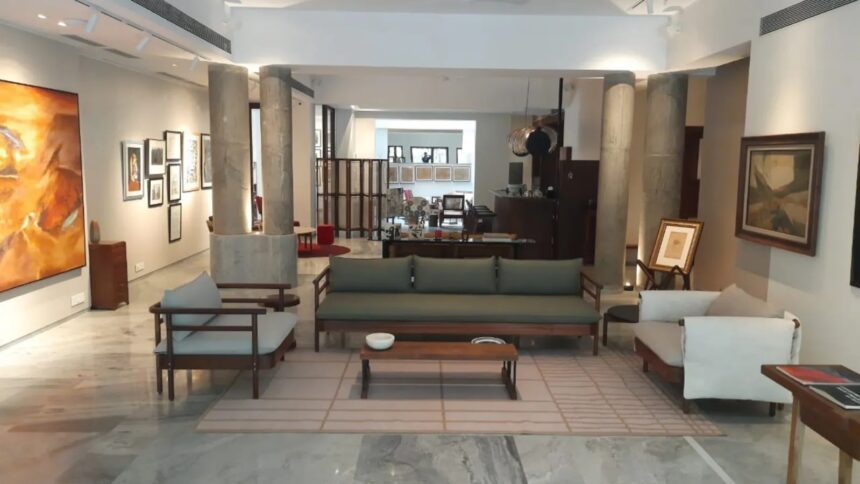
Tucked inside a quiet lane in Mumbai’s Worli, the Kathiwada City House has for at least three generations served as a point where heritage, art, culture, and ideas quietly converge. The low-slung Art Deco structure, with its curved balconies, pastel façade and leafy garden, was originally named West More in the 1940s by the man who built it, the celebrated art collector and former city sheriff Jehangir Nicholson. Since then, the bungalow, possibly one of the few surviving privately owned Art Deco residences of its kind in Mumbai, has undergone several transformations.
Under the stewardship of its present owner, Digvijay Singh Kathiwada, the house has now entered a new chapter. The Kathiwada City House has been opened to the wider public for art and cultural initiatives, paired with a curated dine-in experience. “The idea is for people to dine with the arts,” says Digvijay, whose family traces its lineage to the former princely state of Kathiwada in present-day Madhya Pradesh.
Jehangir Nicholson’s legacy
The house’s association with the arts dates back to its founding. Nicholson, who conceived the bungalow, was one of Bombay’s most influential private art collectors. “A true patron of the arts”, as Digvijay describes him in an interview with .
Nicholson’s belief that art should be accessible to the public ultimately led him to donate his entire collection of over 800 artworks through his estate. Today, this collection forms the basis of the Jehangir Nicholson Art Foundation and is housed at the Chhatrapati Shivaji Maharaj Vastu Sangrahalaya in .
When it came to his own home, however, Nicholson was far more protective. He built the bungalow at a time when Bombay saw a wave of elegant low-rise Art Deco residences commissioned by wealthy patrons of art and business.
His house carries many classic elements of the style, including rounded balconies, geometric railings, and clean horizontal lines. These features echo the design language that reshaped much of Mumbai’s seafront architecture in the 1930s and 40s.
Towards the end of his life, Nicholson lived alone in the four-storey bungalow. Digvijay recounts that “Jangu, as his friends lovingly called him, was known for not selling anything till his dying breath”.
A turning point
Nicholson’s connection with the Kathiwada family began through Digvijay’s mother, Sangita Devi Kathiwada, whom he knew through the Willingdon Club. Recognising her interest in the arts, Nicholson eventually agreed to allow her to use part of the house for cultural programming.
An internal understanding was reached. Nicholson would continue to live on the upper floors, while the ground floor would be made available to Sangita Devi for her artistic and cultural initiatives.
“My mother was very excited about this,” recollects Digvijay, adding that the location of the bungalow in Worli, along with Nicholson’s legacy, made the opportunity impossible to pass up.
The papers were soon signed. Digvijay, who was 18 at the time, remembers meeting Nicholson on the day of the signing. That day also happened to be his birthday. That meeting would prove to be their last. Days later, Nicholson left for a trip overseas, where he passed away.
True to his word, the executors of Nicholson’s estate went ahead with the sale of the ground floor to Sangita Devi. By 2002, they offered her the opportunity to take over the rest of the property as well.
Restoring an Art Deco home
Under Sangita Devi’s stewardship, the bungalow was restored and redesigned to function as a contemporary residence while preserving its heritage character.
Digvijay notes that the family was clear from the outset that the original architecture would be preserved as faithfully as possible. The external façade, doors and windows, and the Art Deco staircase were retained exactly as Nicholson had envisioned them.
The original name of the bungalow, West More, still survives on a plaque at the house. Over time, however, the residence came to be widely known as Kathiwada City House.
Today, the Kathiwada family occupies the upper floors while the ground floor has been dedicated to art, culture and food. The house gradually evolved into a gathering place for the “culturally curious”, bringing together artists, architects, writers, and photographers connected to the family’s cultural network.
From private residence to cultural salon
Around 2020, the house began opening more formally for talks, exhibitions and creative collaborations. Digvijay developed the concept further by launching a private members’ community called Circle 1434. The bungalow functioned as a hybrid venue, part gallery, part salon and part social club, while still retaining its character as a private residence tucked within Worli’s residential lanes.
An important part of this transformation was Bistro Circle 69, curated in collaboration with Aditi Dugar, known for shaping some of Mumbai’s most respected dining experiences. “The idea of having an F&B within cultural spaces has been explored very well by bookstores,” says Digvijay. He wanted to extend the same experience to art galleries.
Opening the house up
The latest phase of Kathiwada City House will see the bungalow opening up more widely to the public. In a press note, Digvijay explains, “Shaped by the belief that culture, whether expressed through food, art, or design flourishes when allowed to evolve naturally, opening the House to a wider public is not a departure from its founding principles but a return to them.”
In the months ahead, the house will continue to evolve through its programming. New spaces such as a sculpture court, contemporary art room, and sports memorabilia room are being planned. The programme will also include collaborative pop-ups, artist group shows, gallery collaborations, culinary residencies, wellness experiences, design showcases and sport-led cultural events.
Among the forthcoming events he is most excited about, Digvijay says, is a contemporary art show and a philanthropy event.
Dining with the arts
The bistro is also set to expand its experience. Guests can expect additions to a menu that regulars already enjoy, alongside seasonal offerings and a newly introduced cocktail programme. While the cuisine leans towards contemporary fusion, the dining experience is designed to interact with the art on display.
Even as he looks ahead, Digvijay remains mindful of the house’s eight-decade-long history. “The legacy and history of the ownership of this house is what makes it stand out,” he says, once again recalling Nicholson’s contribution to Mumbai’s cultural life.
“He loved this city,” Digvijay says, adding that he feels privileged to carry forward his legacy and create a space in Mumbai, where art, culture, and cuisines can intersect in perfect harmony.