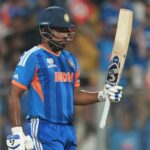
Fitness transformations are often celebrated for their visible results. But what is rarely seen is the physical setback, medical intervention, and mental discipline that sometimes lie behind those changes. In a recent interview with , actor Ahaan Panday shared a lesser-known chapter of his fitness journey. Hesitant at first, he admitted, “I don’t know if I should say this,” before revealing, “I actually got a whole surgery done after the release of last year. And it’s one of the most painful surgeries you can do, with the longest recovery time.”
A few years earlier, he had suffered a shoulder subluxation after a snowmobile incident, he revealed. The lingering injury affected his ability to train the way he wanted, especially ahead of an action film. Despite being warned by his doctor that post-surgery his body would “go back to zero,” making it “nearly impossible” to achieve the physique required for his next project, he chose to go ahead with the procedure. Now, he says he was determined to “prove everyone wrong.”
Reflecting on his fitness journey, he explained, “I used to feel motivated by actors who had dramatic gym transformations. But that was usually from a certain to a healthy one. This was different; I went from being injured, to not being able to move, to not being able to lift, to being able to lift.” He also revealed that he spent months in a cast without most people noticing. “I don’t know how nobody realised!” he said with amusement. While he stays largely offline, some observant followers noticed his weight loss and even reached out to his mother’s social media, asking, “Why is he losing so much weight?” he shared, smiling.
Dr Raghu Nagaraj, director at Institute of Orthopaedics, Sports Medicine and Robotic Joint Replacement at Kauvery Hospitals, , tells indianexpress.com, “From a sports medicine standpoint, ‘going back to zero’ typically refers to the loss of baseline strength, neuromuscular coordination, joint stability, and sometimes even muscle mass following surgery and immobilisation. After a major orthopaedic procedure, especially involving the shoulder, patients often experience significant deconditioning. The muscles around the joint weaken, proprioception reduces, and movement patterns become inefficient.”
However, according to Dr Nagaraj, going back to zero does not mean starting from scratch biologically. The body retains muscle memory at a neuromuscular level. “With structured rehabilitation, progressive loading, and supervised strengthening, regaining peak strength is very realistic in most young and otherwise healthy individuals,” he notes.
“Recovery from a painful orthopaedic surgery is not just a physical process; it is deeply psychological,” stresses Dr Nagaraj. He mentions that patients often experience frustration, anxiety, and even temporary depressive symptoms when they are unable to move or train the way they are used to.
From a clinical perspective, Dr Nagaraj shares, mental resilience plays a significant role in recovery outcomes. Patients who approach rehabilitation with patience and realistic expectations tend to recover better.
After a shoulder subluxation, Dr Nagaraj suggests that rehabilitation “must focus on restoring stability before strength.” The shoulder is a highly mobile joint and relies heavily on muscular support, particularly from the rotator cuff and scapular stabilisers.
“The safest strategy involves phased rehabilitation. Initially, the focus should be on pain control, restoring range of motion, and activating deep stabilising muscles. Once adequate control is achieved, progressive resistance exercises can be introduced, starting with closed-chain movements and gradually transitioning to open-chain and functional strength training. Eccentric strengthening, , and proprioceptive drills are critical in preventing recurrence. High-intensity or overhead training should only be reintroduced once there is demonstrable strength symmetry, no pain, and good dynamic stability,” he notes.
Most importantly, load progression should be gradual and supervised. “Many re-injuries occur not because the surgery failed but because the individual returns to peak training intensity prematurely. A structured, medically guided return-to-training plan is essential for long-term joint health and performance,” concludes Dr Nagaraj.
DISCLAIMER: