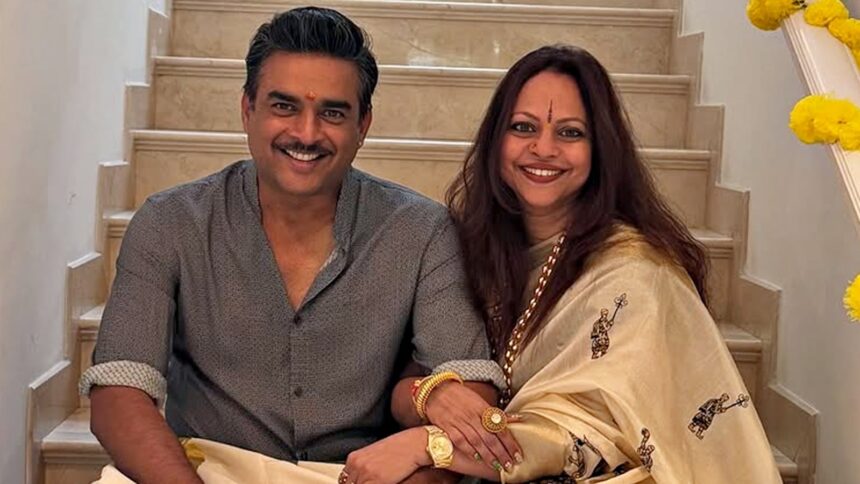
Long before becoming a well-known name in cinema, actor R Madhavan was teaching public speaking and communication skills in Kolhapur. It was there, inside a classroom, that he first met his future wife, Sarita Birje Madhavan. In a recent interaction with alongside Neil Nitin Mukesh, he revisited those early days and explained how the meeting came about. “I was in Kolhapur. She used to be my student.”
Almost immediately, Neil expressed his surprise: “Really? You and met like that? What are you saying? How cool.”
Madhavan continued, “Yes, she was there. She had come to Kolhapur to meet her cousin. The cousin who used to come to my classes because I was teaching . She got irritated and asked where her cousin was going for 3-4 hours to study, when she came for a holiday. So, one day, she decided to accompany her to my classes and found my teaching interesting.” At the time, their interaction remained strictly professional.
He clarified that there was no romance during the teacher-student phase. “At that time, we didn’t have any romance. I will say it very clearly. I didn’t have any romance with my student.” Only after she completed the course and moved ahead in her career, eventually becoming an air hostess, did their dynamic shift. As a gesture of thanks, she invited him to dinner, which became a turning point in their story. Recalling that evening, he said with a smile, “We went to a hotel in Kolhapur for dinner, and since then… she has been treating me.”
What began as a professional association gradually evolved into a deeper relationship. The couple dated for eight years before marrying in 1999 in a traditional Tamil ceremony. Six years later, in 2005, they welcomed their son, Vedaant.
Gurleen Baruah, organisational psychologist at That Culture Thing, tells indianexpress.com, “When something starts in a student-teacher space, the first lens to look through is power and boundaries. That dynamic automatically carries influence, authority, and possible bias, so ethics matter a lot. It’s not just about two people; it affects fairness, judgment, and the larger environment.”
She continues, “However, if a connection develops much later in life, after roles have clearly ended and there’s no dependence or influence left, that’s different. Context, timing, and whether any power imbalance still exists are key. What matters most is that the relationship doesn’t misuse authority or blur professional responsibility.”
“This is very important and often missed when emotions are involved,” notes Baruah, adding that people may feel things genuinely, but they still need to pause and think about the larger picture, such as workplace impact, fairness, and whether the other person feels truly free to choose.
She states, “Consent here must be explicit, unpressured, and equal, not influenced by past hierarchy. Transparency helps by being honest with each other and, where relevant, with institutions too. Individuals should reflect carefully, check intentions, and be willing to step back if there’s even a small doubt about imbalance.”
Baruah explains, “There’s no fixed checklist, as every relationship is different. Some work, some don’t, and that’s okay. What people can control are things like openness, honesty, and . Being able to talk about the past dynamic without defensiveness, making sure neither person feels smaller or indebted, and building equality in the present really matters.”
When both people meet as individuals (not roles), the relationship has a better chance. Ultimately, healthy partnerships depend less on how they started and more on how consciously they are built.